

14 min read
In this article
- Labour accommodation in Dubai in short
- Labour accommodation rules in Dubai: three situations to tell apart
- Who regulates workers' accommodation in Dubai
- Dubai Municipality requirements for workers' accommodation: the building and the rooms
- Sleeping rooms
- Kitchens, dining halls and laundry
- Toilets, showers, first aid and safety
- Documents, contracts and the health and safety officer
- Inspections and compliance grades
- Temporary labour accommodation on a construction site
- A prayer room on construction sites
- What this means for villa and building contractors
- Earlier rules and model accommodation
- Related services
- Frequently asked questions
- What are the Dubai Municipality requirements for labour accommodation?
- How much space does each worker need in labour accommodation in Dubai?
- Do these rules apply to a small villa or annex project?
- Need a contractor who plans it properly?
- Official sources
Labour accommodation in Dubai is regulated by Dubai Municipality (DM) through its Health and Safety Department, and the rules differ depending on whether workers live in a permanent labour accommodation building or in a temporary camp on a construction site. This guide explains the DM requirements for workers' accommodation from the official documents: room space and beds, kitchens and bathrooms, the inspection and grading system, the safety officer, and what it all means for a contractor running a villa or building site.
Labour accommodation in Dubai in short
- DM's technical guideline on labour accommodation compliance (DM-HSD-GU85-LAC1, edition 5, 30 September 2025) applies to all permanent labour accommodation in the Emirate of Dubai. It is the main reference for the standards below.
- The minimum in a sleeping room is 3 m² of floor area per person, with 8 to 10 workers at most in one room, each worker having an individual bed and a lockable wardrobe.
- Sanitary facilities are counted per person: at least one toilet, one shower and one hand-wash basin for every 8 people, and one urinal for every 25.
- DM inspects labour accommodation and gives each one a compliance grade from A (highest) down to F. Inspections can be routine, follow-up, based on a management decision, triggered by a complaint, or random sampling.
- A temporary camp at a work site is a different case: the Safety Guide for Construction Works says no temporary accommodation may be built at a work site without the approval of the concerned DM department.
- Since July 2025 DM has also asked developers, consultants and contractors to provide a temporary prayer room on construction sites (circular 12-13-1).
Labour accommodation rules in Dubai: three situations to tell apart
People say "labour camp" for several different things, and DM's documents treat them separately.
- Permanent labour accommodation: a building or group of buildings dedicated to housing workers, licensed by the building licensing authorities. DM defines "labour accommodation" in guideline GU85 as any building or group of buildings designated for workers' housing, and the guideline covers every permanent one in Dubai.
- Temporary accommodation at a work site: rooms or cabins on the construction site itself. The Safety Guide for Construction Works (section 3-8, page 28) sets the conditions, starting with prior approval.
- Welfare facilities on site: not housing, but the facilities that keep workers on the site safely and comfortably, such as the temporary prayer room described in circular 12-13-1 of 2025.
For a villa, annex or small building project, most crews live in permanent accommodation arranged by the contractor, so the first group of rules is the one a good contractor already works to. The site rules matter when the contractor wants to house workers on the plot.
Who regulates workers' accommodation in Dubai
Within DM, the Health and Safety Department supervises compliance with health and safety standards in buildings and establishments, and the guideline is issued by its labour cities control section. The guideline names the legal basis it builds on, including Local Order 11 of 2003 on public health and community safety and its executive regulation, administrative decision 128 of 2007 on the conditions for labour accommodation complexes, and Executive Council Resolution 12 of 2025 on providing accommodation for workers of establishments in Dubai.
Executive Council Resolution 12 of 2025 was issued on 3 March 2025 (3 Ramadan 1446) by Hamdan bin Mohammed bin Rashid Al Maktoum, Crown Prince of Dubai and Chairman of the Executive Council. The text on the Dubai Legislation Portal has three articles. Article 1: establishments licensed by the concerned commercial licensing authority in the emirate that employ 50 or more workers whose wage is AED 2,000 or less must provide accommodation for those workers. Article 2: they must comply within one year of the effective date, and the Executive Council may extend that period once for the same period. Article 3: the resolution comes into force 90 days after its publication in the Official Gazette. The portal notes that the Arabic text prevails.
Dubai Municipality requirements for workers' accommodation: the building and the rooms
Guideline GU85 (section 5-1, page 7) starts with the building. It must be built under a licence from the competent building authorities, materials containing asbestos or any substance harmful to health or the environment are banned, and floors must be impervious, non-slip, easy to clean and free of cracks and holes. The residential-building rules for ventilation, lighting, electrical installations, insulation and room dimensions apply to the sleeping rooms, and all rooms, kitchens and dining halls must be air-conditioned. A signboard on the facade must show the details of the company responsible, and the guideline requires compliance with the Dubai Building Code. This is why the permit drawings for an accommodation building, like any other, are prepared by a DM-registered engineering office (see our building permit guide and the Dubai Building Code guide), and the contractor then builds to the approved drawings.
Sleeping rooms
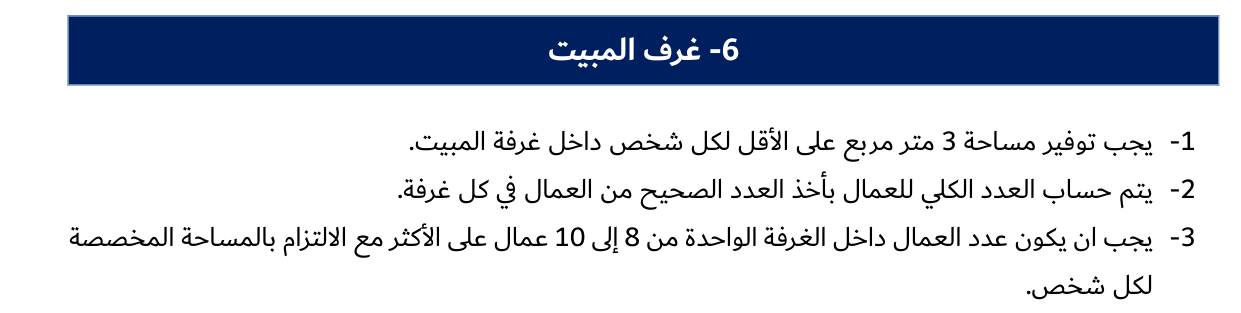
Section 6 of GU85 (pages 8 and 9) sets the room rules in numbers. They are easy to check on a visit, which is what an inspector does.
| Item | Requirement in GU85 | Clause |
|---|---|---|
| Floor area | At least 3 m² per person inside the room | 6-1, page 8 |
| People per room | 8 to 10 workers at most, while keeping the area per person | 6-3, page 8 |
| Sleeping place | An individual sleeping place for each worker, not shared; bed with mattress, pillow, cover and clean sheet | 6-4 and 6-5, page 9 |
| Storage | A lockable wardrobe about 2 m high for each person; shoe racks outside the room | 6-6 and 6-11, page 9 |
| Bed height | Bed at least 30 cm above the floor | 6-7, page 9 |
| Bunk beds | Not preferred; if used, at least 120 cm between beds on both sides and at least 70 cm between the upper and lower bed; three-tier bunks not allowed | 6-8 and 6-10, page 9 |
| Air and light | Ventilation, cooling and suitable lighting in the rooms | 6-12, page 9 |
Kitchens, dining halls and laundry
Where each unit has its own kitchen, the cooking surfaces, sinks and floors are to be cleaned at least twice a day and the kitchen deep-cleaned at least once every three months (section 7-1, page 9). A community kitchen or catering service needs an annual permit from the competent DM department, a register of its staff and valid health cards (section 7-2, page 10). A dining hall must have enough tables and chairs, cool drinking water and a hand-washing point, and it must hold one third of the total number of workers at one time (section 8, pages 11 and 12). Laundry rooms (section 9, page 12) go on the ground floor of the accommodation, with water-resistant walls and floors and good ventilation, and the laundry area is kept separate from the living, eating and kitchen areas; clothes soiled with hazardous materials such as pesticides may not be washed in the accommodation's laundries.
Toilets, showers, first aid and safety
- Sanitary facilities (section 11, page 12): at least one toilet, one shower and one hand-wash basin for every 8 people, one urinal for every 25, with hot and cold water, water-resistant easy-to-clean floors and walls, and regular cleaning with approved materials.
- First aid room (section 10, page 12): at least one, with enough furniture and a cabinet holding the first aid supplies.
- Fire and building safety (section 13, pages 13 and 14): a valid certificate from the Dubai Civil Defence confirming the fire protection requirements, electrical sockets and connections in good condition, lift safety certificates, and storage rules (items at least 20 cm above the floor, 50 cm below the ceiling and 30 cm from the wall).
Documents, contracts and the health and safety officer
Section 5-3 of GU85 (page 8) asks the operator to keep a current set of documents on site. It lists the tenancy contract registered with the competent government entity, cleaning contracts for water tanks by a DM-approved company, pest control, air-conditioning cleaning and grease trap contracts with their periodic reports, lift maintenance with safety certificates, fire system maintenance, the community kitchen or catering permit and the health cards of its workers, and a lifeguard certificate if there is a pool.
The guideline also requires a qualified, certified health and safety officer resident inside the accommodation (section 5-2, page 8), under DM's certification scheme (DM-HSD-GU131-CSLA2, version 1.1, 16 October 2024). The scheme sets the number by size:
| Rooms in the accommodation | Size class | Certified officers needed |
|---|---|---|
| 101 rooms or more | Large | Two |
| 51 to 100 rooms | Medium | One |
| 50 rooms or fewer | Small | Not required |
The table in the scheme (section 2.7 to 2.8, page 8) applies to permanent or temporary accommodation. Certificates last three years, the examination pass mark is 20 out of 30, and the officer has to be recertified before the end of the third year (sections 2.1 to 2.3, pages 7 and 8). The same scheme says an officer can be asked to retrain if routine inspections give a poor grade that comes from poor management (section 2.4, page 8).
Inspections and compliance grades
Section 4 of GU85 (pages 6 and 7) explains how DM checks compliance. There are five kinds of inspection:
- Routine: scheduled automatically by DM's smart inspection system according to the accommodation's classification and risk level.
- Follow-up: checks that the corrective actions in an earlier report were done within the stated period.
- By management decision: ordered by a DM manager or their delegate.
- Following a report: triggered by reports from individuals or the public through the official channels.
- Sampling: random sample visits by judicial enforcement officers.
After the final assessment the inspection report records a compliance level in category A (the highest), then B, C and the descending non-compliance categories D down to F. Violations carry fines under Local Order 11 of 2003 and its executive regulation, and the operator keeps the right to object within the period stated in the inspection report. Suggestions and complaints go to DM through the 04 platform, the 800900 contact centre or Click to show the email address (section 5-4, page 7). Our violations guide covers the building side of fines.
Temporary labour accommodation on a construction site
If a contractor wants to house workers on the plot, the Safety Guide for Construction Works in Dubai applies. Section 3-8, "Temporary accommodation sites" (page 28), sets out five points.
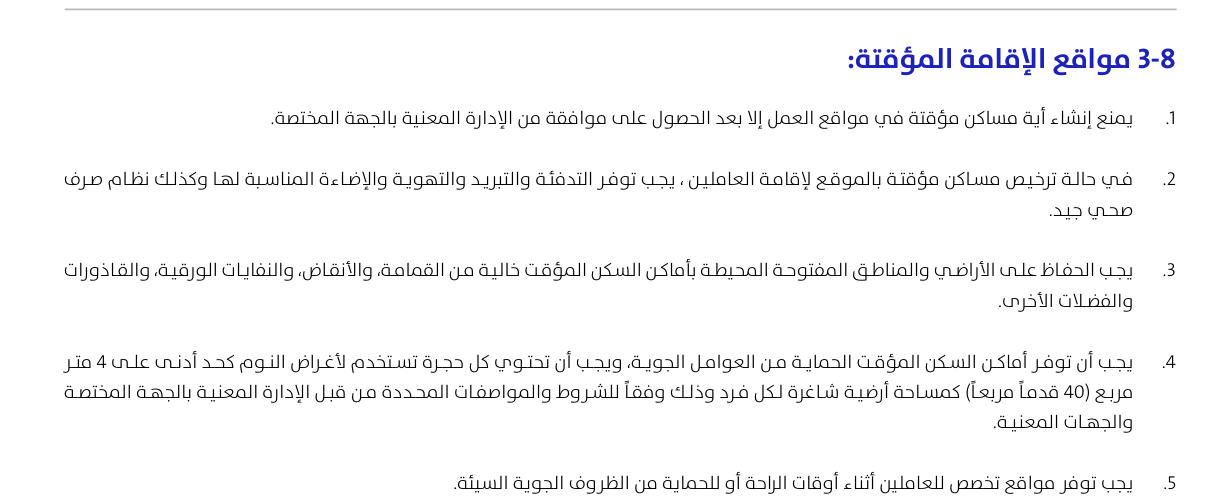
- No temporary accommodation may be built at a work site without approval from the concerned DM department.
- Where it is licensed, it must have heating, cooling, ventilation, suitable lighting and a good sanitary drainage system.
- The land and open areas around it are kept free of rubble, rubbish, paper waste and other waste.
- The accommodation must be protected from weather, each room used for sleeping must offer at least 4 m² (about 40 square feet) of free floor area per person, and the specifications follow the concerned department and authorities.
- Shaded areas are provided for the workers' rest breaks or for protection from poor weather.
Note that the 4 m² figure is the site guide's figure for temporary accommodation, while the 3 m² figure in section 6 of GU85 is for permanent accommodation. If your contractor is proposing to house a crew on your plot, ask which approval applies and for a copy of it before anyone moves in.
A prayer room on construction sites
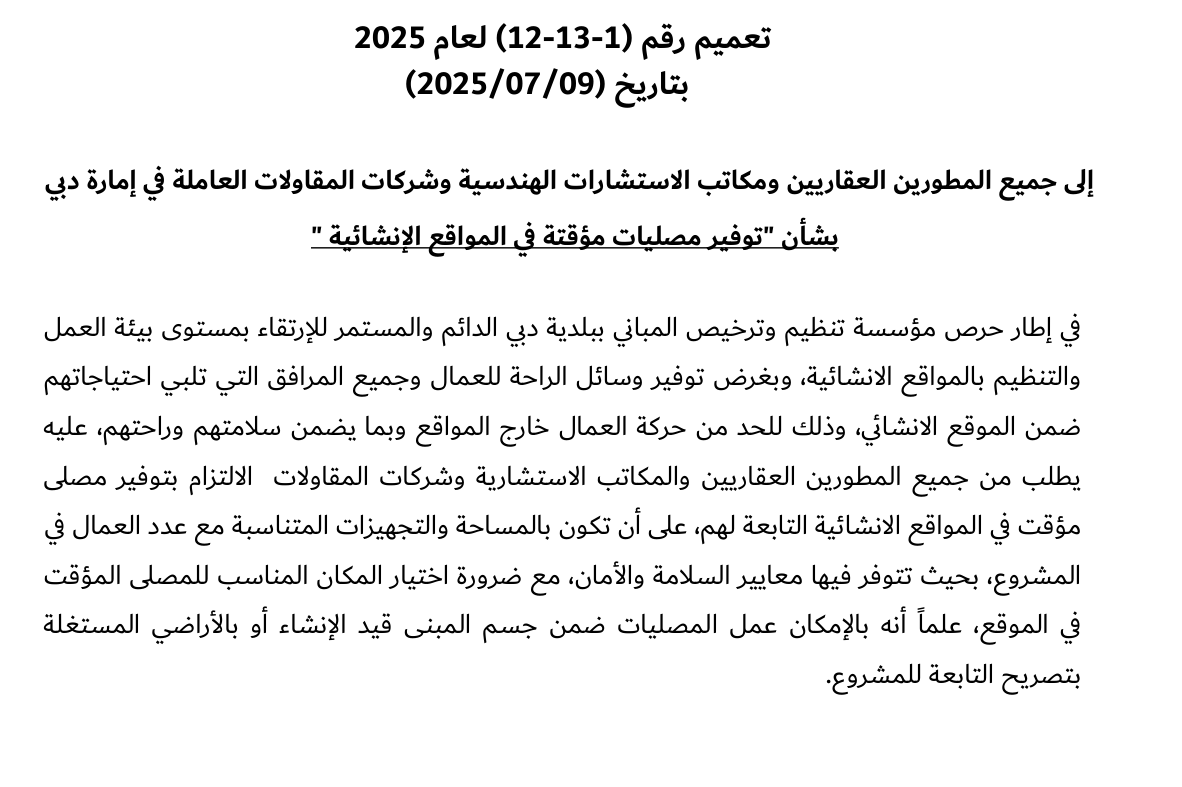
On 9 July 2025 DM issued circular 12-13-1 to real estate developers, engineering consultancy offices and contracting companies in Dubai, to improve the working environment and provide rest facilities that meet workers' needs inside the site, which also limits movement of workers outside it. It asks them to provide a temporary prayer room at each construction site under their responsibility, sized and equipped for the number of workers on the project, in a suitable place with safety standards. It also notes that prayers can be held inside the building under construction or on land used under the project's permit.
What this means for villa and building contractors
These questions come straight from the documents above and are not a legal checklist, but they are sensible to put to any contractor you appoint.
- Where does the crew live? If it is a permanent labour accommodation, it is covered by GU85 and subject to DM inspection and grading. Ask your contractor to confirm that the accommodation they use is licensed and operated under those rules.
- Will anyone sleep on the plot? If so, ask for the DM approval for temporary accommodation first (Safety Guide, section 3-8). Without it, none should be built.
- Is there a welfare plan for the site? Shaded rest areas and, as circular 12-13-1 asks, a prayer room sized for the number of workers on the project.
- Who is responsible for the crew's housing records? The contractor, as employer, keeps contracts, certificates and health cards in order, the same way site safety paperwork is kept; see our site safety guide.
- Are the contractor and the materials properly approved? That is a separate question covered in the guide to approved materials and contractors.
A contractor who plans crew housing and site welfare from the start keeps the job smooth during Dubai Municipality inspections.
Earlier rules and model accommodation
Administrative decision 128 of 2007 on the conditions for labour accommodation complexes (article 1, pages 1 to 5) is the older instrument many documents still refer to. It set 40 square feet of room space per worker, at most eight workers per room and one toilet, wash basin and shower for each eight workers, and GU85's reference list (page 14) still cites it. The 2025 guideline's own numbers, for example 3 m² per person and 8 to 10 workers per room, are the current inspection reference, so if the figures differ, follow the guideline and ask DM to confirm which document applies to a specific building.
DM also has a "model labour accommodation" classification that owners can apply for (guideline DM-HSD-GU128-LAM1, version 2, 19 June 2024, pages 5 to 7). To qualify, an accommodation first meets all of GU85, scores at least 95 to 100 (an A+) in its latest routine inspection report and meets at least 80% of the model requirements, such as at least 4 m² per person in living rooms, a community kitchen or suitable individual kitchens, an isolation room for infected workers, and an emergency plan with drills. It must also meet at least 80% of the welfare standards in section 8, such as TV and sports facilities, greenery inside the accommodation and at least 5 litres of drinking water per person per day.
Related services
Read about our annex construction contractor in Dubai service and our contractor checklist.
Frequently asked questions
What are the Dubai Municipality requirements for labour accommodation?
DM's guideline GU85 covers the building licence, room space and beds, kitchens, dining halls, laundries, bathrooms, first aid, fire safety, water and air quality, documents and a certified health and safety officer. DM inspects against it and grades each accommodation from A to F.
How much space does each worker need in labour accommodation in Dubai?
Permanent accommodation needs at least 3 m² per person inside the sleeping room, with 8 to 10 workers at most per room (GU85, section 6). Temporary accommodation at a work site needs at least 4 m² of free floor area per person (Safety Guide, section 3-8).
Do these rules apply to a small villa or annex project?
The permanent accommodation rules apply to the accommodation building wherever the crew lives. The site rules apply to any construction site. Your contractor can show you how they meet them for your plot.
Need a contractor who plans it properly?
We are happy to talk through your project and how the site will be run. Message us on WhatsApp, use the contact page, try the free cost calculator or browse our projects.
This article summarises official Dubai Municipality documents for owners and contractors. The official DM website and the current versions of the documents prevail.
Official sources
- Technical Guideline for Labour Accommodation Compliance, DM-HSD-GU85-LAC1, edition 5 (30 September 2025)
- Certification Scheme for Health and Safety Officer in Labour Accommodations, DM-HSD-GU131-CSLA2, version 1.1 (16 October 2024)
- Technical Guideline for Model Labour Accommodation, DM-HSD-GU128-LAM1, version 2 (19 June 2024)
- Administrative Decision No. (128) of 2007 on the conditions for establishing labour accommodation complexes
- Safety Guide for Construction Works in the Emirate of Dubai, section 3-8
- Circular 12-13-1 (2025): providing temporary prayer rooms at construction sites
- Executive Council Resolution No. (12) of 2025 on the provision of accommodation for workers employed at establishments in the Emirate of Dubai (Dubai Legislation Portal)
Planning your next project?
Talk to the Al Mustafa team for advice and a quotation for your project in the UAE.
Related articles
 17 November 2026Periodic Inspection of a Villa Electrical Installation in Dubai: Alterations, Labels and Upkeep After HandoverRead article
 15 November 2026Building an Annex or Majlis with MBRHE Support: A Practical GuideRead article