

15 min read
In this article
- AC units in a villa annex and DEWA in short
- DEWA under voltage relay for air conditioners: 75 percent in 0.2 seconds
- The auto-reset timer: 5 to 10 minutes, and why the AC restarts by itself
- Motorised auto-closing breaker or contactor and who sets the timer
- Where the under voltage relay for an AC unit can sit
- What the relay must not trip: the main incomer
- Power factor for annex AC loads: 0.9 lagging to unity, recommended 0.95
- Planning AC for an annex or majlis: what to put on the drawings
- What is checked at LV inspection and the after-installation confirmation
- Keeping the relay working: regular checks
- Out of scope: large chillers
- Where these rules sit: the circular, the 2017 Regulations and the Dubai Building Code
- How Al Mustafa Contracting coordinates the electrical and AC scope
- Frequently asked questions
- Does every AC unit in a villa annex need a UV relay?
- At what voltage does the relay trip?
- Why does my AC restart on its own after a power cut?
- Can the relay be in the distribution board?
- Can the relay trip the whole villa or annex?
- Who decides the timer setting?
- What power factor should AC units have?
- Does anything have to be confirmed to DEWA after installation?
- Need help planning AC and electrical loads for your annex?
- Official sources
A DEWA under voltage relay for air conditioners is one of the first electrical rules a villa owner meets once an annex (service block), majlis or extension has air conditioning on its drawings. DEWA's position is simple: every air-conditioning unit in a consumer installation is provided with an under voltage (UV) relay with an auto-reset timer, and DEWA's September 2021 circular sets out how that relay should behave. This guide walks through the circular and the 2017 Regulations clauses it clarifies, in plain language, so you can ask your engineer and your AC supplier the right questions before the design goes to DEWA.
AC units in a villa annex and DEWA in short
- DEWA requires every air conditioner and air-conditioning unit, plant or equipment installed within a consumer's installation to have a UV relay with an auto-reset timer (2017 Regulations, cl. 1.10 and 8.2.1).
- The relay trips the breaker or contactor when the supply voltage falls to or below 75 percent of nominal for 0.2 seconds, with no intentional delay.
- The auto-reset timer is adjustable between 5 and 10 minutes, and the breaker or contactor must close again by motorised operation when the relay resets.
- The relay normally sits inside the AC unit or its control panel. For normal air conditioners it may sit in the distribution board, but only with DEWA's prior approval for each application.
- The relay must not be used to trip the LV incomer circuit breaker or ACB in the Main LV Panel.
- Relays and their controls are checked and maintained regularly, and the 75 percent threshold and tripping time are confirmed to DEWA after installation.
These rules apply to the consumer's installation, so they cover the annex's split units and any other AC equipment, not only the villa's main system. DEWA-enrolled consultants and contractors know this requirement well; treating it as a standard item on the design checklist protects you at approval and at inspection.
A note on the design clauses: DEWA's circular DP-VP-CS-GEN-0008-2022 (17 January 2022) says the clauses applicable to electrical design are now incorporated in the Dubai Building Code issued by Dubai Municipality, mostly under Parts G and K, while the 2017 Regulations still carry the operation, periodic inspection and maintenance clauses. Where this guide cites the 2017 Regulations for a design requirement, your engineer confirms the current wording. The section on where these rules sit, below, gives the detail.
DEWA under voltage relay for air conditioners: 75 percent in 0.2 seconds
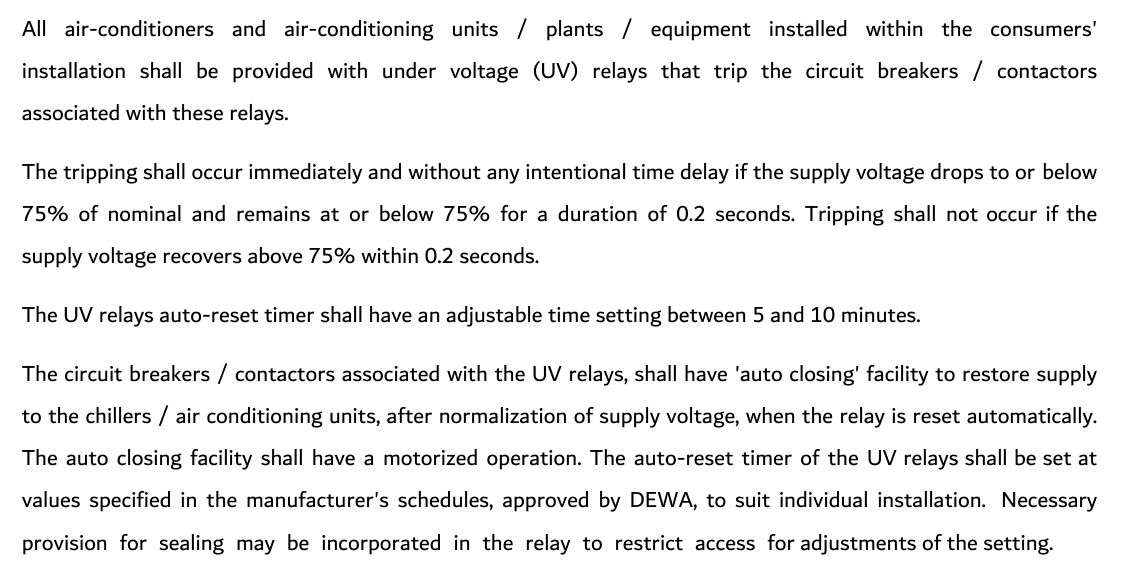
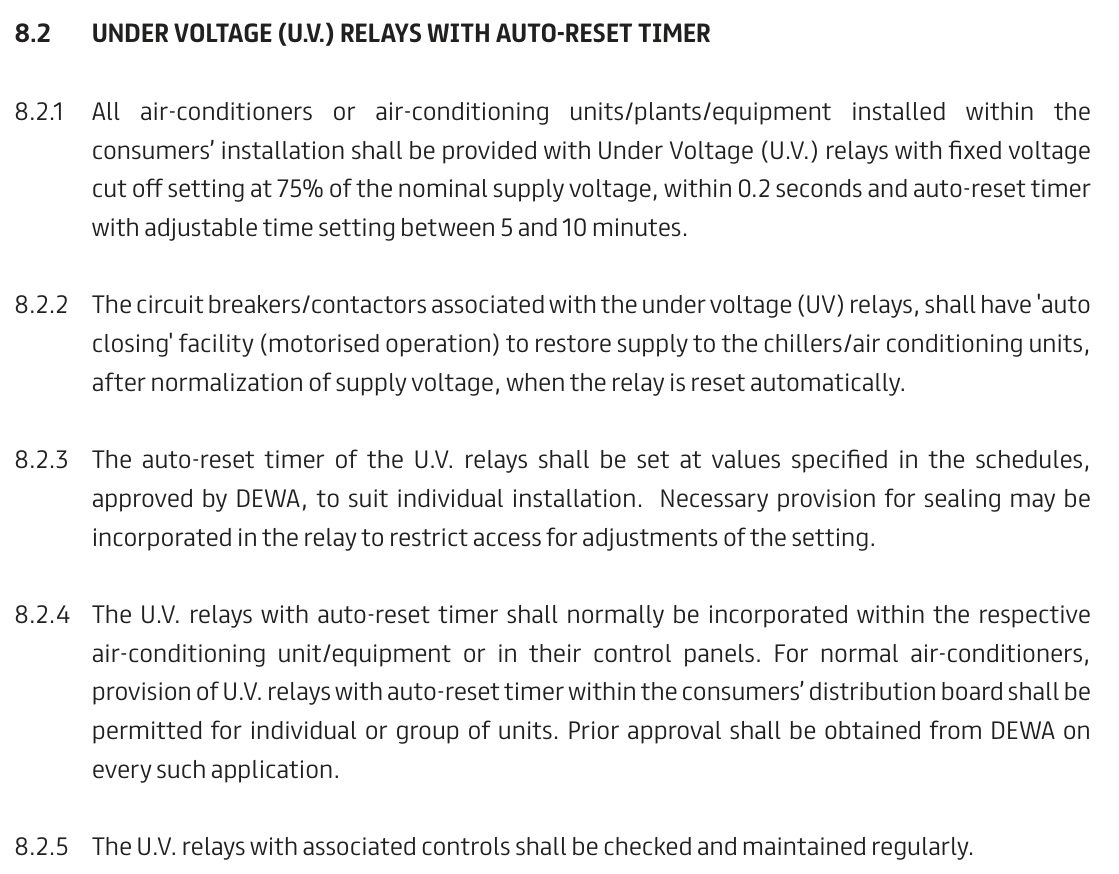
Clause 8.2.1 of the 2017 Regulations asks for UV relays with a fixed voltage cut-off setting at 75 percent of the nominal supply voltage, within 0.2 seconds. DEWA's circular DP-VP-CS-GEN-0153-2021 (23 September 2021) was issued to clarify clauses 8.2.1 and 8.2.2 and says the following on tripping:
- The relay trips the circuit breakers or contactors associated with it.
- Tripping occurs immediately, without any intentional time delay, if the supply voltage drops to or below 75 percent of nominal and stays at or below 75 percent for 0.2 seconds.
- Tripping does not occur if the voltage recovers above 75 percent within those 0.2 seconds.
In other words, a very brief dip that recovers within 0.2 seconds does not trip the unit, while a sustained drop does. The circular says the relays are applied to trip the air-conditioning equipment that is sensitive to voltage variations.
The auto-reset timer: 5 to 10 minutes, and why the AC restarts by itself
The circular states that the auto-reset timer of the UV relay has an adjustable time setting between 5 and 10 minutes. Once the supply voltage has normalised and the relay resets automatically, the breaker or contactor closes by itself and supply returns to the air-conditioning unit. That is why an AC unit in a villa can switch off after a supply disturbance and come back on without anyone pressing a button.
For the household this has a practical meaning. If a unit restarts after several minutes, that is consistent with the auto-reset and auto-closing arrangement the circular describes; ask your AC contractor to confirm the setting. Your engineer or AC contractor can tell you the value set on each unit. If a unit does not restart at all, ask the contractor to check the relay and its auto-closing breaker; do not bypass the relay.
Motorised auto-closing breaker or contactor and who sets the timer
Clause 8.2.2 of the 2017 Regulations and the circular both require the breaker or contactor associated with the relay to have an auto-closing facility. Both clause 8.2.2 ("motorised operation") and the circular ("shall have a motorized operation") require the auto-closing to be motorised. This is a hardware point to settle with the AC or panel supplier, because an ordinary manual breaker does not meet the description.
On the timer value, the circular says the auto-reset timer is set at values specified in the manufacturer's schedules, approved by DEWA, to suit the individual installation (clause 8.2.3 says values specified in the schedules approved by DEWA; the circular adds the reference to the manufacturer's schedules). It also says provision for sealing may be incorporated in the relay to restrict access for adjustments of the setting. So the owner does not choose the number: the manufacturer's schedule and DEWA's approval do. Ask the supplier for that schedule when AC equipment is selected, so it is available for the submission.
Where the under voltage relay for an AC unit can sit
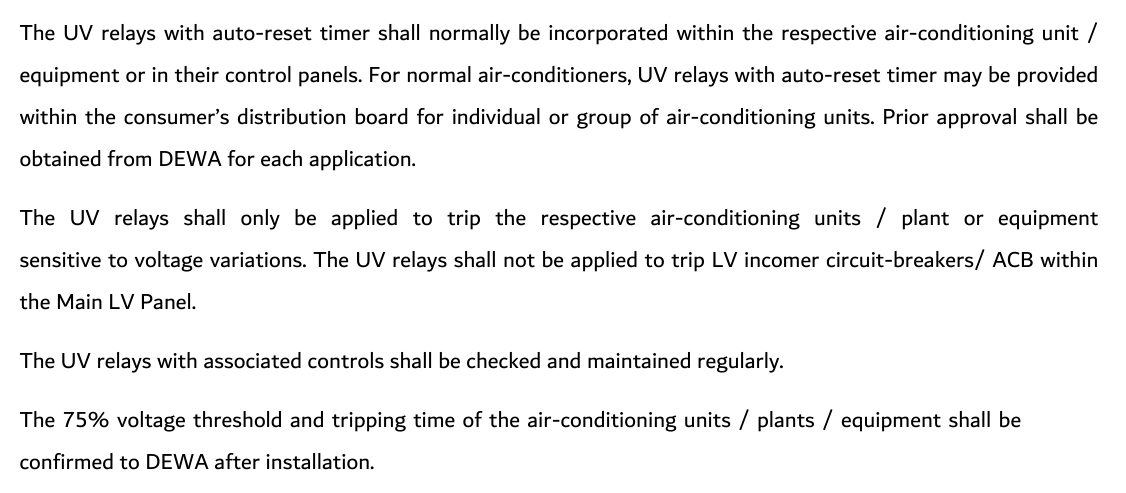
The circular and clause 8.2.4 give the same two options:
| Location | What DEWA states |
|---|---|
| Inside the AC unit or its control panel | This is the normal arrangement: the relay is normally incorporated within the respective air-conditioning unit or equipment or in its control panel. |
| In the consumer's distribution board (DB) | For normal air conditioners the relay may be provided in the DB, for an individual unit or a group of units. Prior approval shall be obtained from DEWA for each application. |
The documents we reviewed do not define what DEWA counts as a "normal" air conditioner, so do not assume a particular unit type qualifies. Raise it with your consultant early, because a relay placed in the DB needs DEWA's approval for that application and needs space and wiring in the board.
What the relay must not trip: the main incomer
The circular is clear on this point: UV relays are applied only to trip the respective air-conditioning units, plant or equipment sensitive to voltage variations, and they shall not be applied to trip the LV incomer circuit breakers or ACB within the Main LV Panel. In a small villa installation, that means the relay acts on the AC circuit, never on the incomer that feeds the whole building.
Power factor for annex AC loads: 0.9 lagging to unity, recommended 0.95
The circular is about under-voltage tripping, but air conditioners come with a second DEWA requirement: power factor. These are design clauses, so note the position stated in DEWA's circular DP-VP-CS-GEN-0008-2022 (17 January 2022): the design clauses are now incorporated in the Dubai Building Code, mostly Parts G and K, while the 2017 Regulations still carry the operation, periodic inspection and maintenance clauses; your engineer confirms the current wording. The 2017 Regulations, clause 1.9 (PDF page 10), say the overall power factor of every consumer installation is to be kept within 0.9 lagging and unity, with a recommended value of 0.95 lagging. The same clause says that, generally, central air-conditioning plants and window and split units shall incorporate integral means of power factor correction, to achieve and maintain a power factor not less than 0.9 lagging throughout their normal working range.
Clause 8.1.1 repeats the 0.9 lagging to unity range (PDF page 65). Clause 8.1.2 goes a step further and says that, in general, air-conditioning units/plants/equipment, machines, motors and light fittings with discharge lamps shall be provided with capacitors or other approved means to achieve and maintain 0.95 lagging or above. The two clauses quote different figures, 0.9 and 0.95, so let your engineer confirm which value applies to the units on your drawing and make sure the supplier's datasheet states the unit's power factor.
Clause 8.1.18 (PDF page 66) covers premises without capacitor banks where the individual equipment has its own correction: a power factor meter is to be provided in the Main Distribution Board to display the power factor, and if it deviates from the requirement the customer arranges correction equipment to keep it close to 0.95 lagging. For a villa with an annex, ask your engineer whether this clause applies to your board.
Planning AC for an annex or majlis: what to put on the drawings
An annex or majlis is often added to a plot after the main villa, and the air conditioning can be chosen late. Because DEWA's prior approval is needed if the relay sits in the DB, and the 75 percent threshold and tripping time are confirmed to DEWA after installation, it is worth settling the following during design:
- Equipment schedule: list every AC unit with its rating, so the load summary matches the equipment you will install. If the load grows later, see our guide to increasing the electrical load.
- Relay arrangement: decide with the supplier whether the relay is built into each unit or control panel, or provided in the DB. If in the DB, plan the space and the request to DEWA for that application.
- Manufacturer's schedule: obtain the relay and timer details so the setting follows the schedule approved by DEWA.
- Auto-closing device: confirm that the breaker or contactor associated with each relay is motorised.
- Power factor: record the unit's power factor or correction method from its datasheet.
- Board layout: the DB has to fit the relays, breakers and any power factor meter your engineer specifies, and stay accessible.
Choosing the AC type also interacts with the insulation, glazing and layout of the building, which our guides on the green building rules and thermal insulation and external majlis design touch on. Design-stage electrical requirements are checked against the Dubai Building Code at DEWA design approval (see the section on the code below), so keep the AC schedule in step with the drawing set described in our building permit guide.
What is checked at LV inspection and the after-installation confirmation
The Inspection and Testing Certificate in Appendix 3 of the 2017 Regulations (PDF page 96) is the form that records the installation's verification. One of its checklist lines reads that under voltage relays with associated contactors or motorised breakers are verified and found to be correct. This is the point where the contractor's inspection and the relay arrangement meet, so it should not be left to the last day.
Separately, the circular says the 75 percent voltage threshold and the tripping time of the air-conditioning units, plants or equipment shall be confirmed to DEWA after installation. The circular does not describe the form or channel for that confirmation, so ask your consultant or contractor how it will be recorded for your project. For the inspection steps in full, see our DEWA LV inspection checklist for a villa annex. For how the inspection request itself fits into the connection steps, see our guide to the DEWA electricity connection for a villa annex. For the municipality side of completion, see the completion certificate and inspections guide.
Keeping the relay working: regular checks
The circular and clause 8.2.5 both say UV relays with their associated controls shall be checked and maintained regularly. After handover the owner is the one living with the installation, so agree with your AC contractor how the relay, timer and auto-closing breaker will be included in routine AC servicing, and keep any sealing intact so that settings are not altered without authority. The documents we reviewed do not set a service interval, so we do not state one.
Out of scope: large chillers
DEWA also has an older circular, HCS/21/2004 (9 March 2004), about chillers above 100 kW connected to a DEWA transformer through a consumer's private LV panel. That is a different situation from a villa annex supplied at low voltage with split or ducted units, so we do not cover it here.
Where these rules sit: the circular, the 2017 Regulations and the Dubai Building Code
Three documents are involved, and it helps to know which does what:
- The DEWA Regulations for Electrical Installations, 2017 Edition contain the original wording: clause 1.10 (PDF page 11) and clauses 8.2.1 to 8.2.5 (PDF page 67).
- The UV relays circular DP-VP-CS-GEN-0153-2021 clarifies clauses 8.2.1 and 8.2.2 and says its clarification and amendment is to be considered part of those clauses.
- DEWA's circular DP-VP-CS-GEN-0008-2022 (17 January 2022) says that the clauses applicable to electrical design are incorporated in the Dubai Building Code issued by Dubai Municipality, mostly under Part G and Part K, that compliance is mandatory and is verified during drawing submissions for DEWA design approval, and that the 2017 Regulations still include the clauses on operation, periodic inspection and maintenance.
So when we cite the 2017 Regulations for a design requirement here, read it as the source text DEWA published, and have your engineer confirm the current wording in the Dubai Building Code. Our Dubai Building Code guide for annex owners explains how the code is organised.
How Al Mustafa Contracting coordinates the electrical and AC scope
We plan the electrical scope together with the owner, the engineering office and our engineers, so the AC schedule, the board layout and the DEWA documents move with the rest of the build. Practically, that means asking the AC supplier early for the relay arrangement and manufacturer's schedule, keeping the installation in line with the approved drawings, and telling the owner when DEWA needs an inspection or confirmation. Our contractor checklist and annex cost guide show where these steps sit in a project.
Frequently asked questions
Does every AC unit in a villa annex need a UV relay?
Yes. DEWA's 2017 Regulations (clauses 1.10 and 8.2.1; see the note on the Dubai Building Code above) and the 2021 circular say all air conditioners and air-conditioning units, plants or equipment within the consumer's installation shall be provided with UV relays with an auto-reset timer.
At what voltage does the relay trip?
At or below 75 percent of nominal, if it stays there for 0.2 seconds, with no intentional delay. It does not trip if the voltage recovers above 75 percent within 0.2 seconds.
Why does my AC restart on its own after a power cut?
The auto-reset timer is adjustable between 5 and 10 minutes, and the motorised breaker or contactor closes again when the relay resets after the supply normalises. Ask your contractor for the value set on your units.
Can the relay be in the distribution board?
For normal air conditioners, yes, for an individual unit or a group of units, but DEWA's prior approval is needed for each application. The normal location is inside the unit or its control panel.
Can the relay trip the whole villa or annex?
No. The circular says UV relays shall not be applied to trip the LV incomer circuit breakers or ACB in the Main LV Panel.
Who decides the timer setting?
It is set at the values in the manufacturer's schedules approved by DEWA, to suit the installation, not chosen freely by the owner.
What power factor should AC units have?
The 2017 Regulations state 0.9 lagging to unity for the installation, recommended 0.95, and for air-conditioning units clause 8.1.2 asks for 0.95 lagging or above. These are design clauses, which DEWA's circular DP-VP-CS-GEN-0008-2022 says are now incorporated in the Dubai Building Code, so your engineer confirms the current wording and which value applies to your units.
Does anything have to be confirmed to DEWA after installation?
The circular says the 75 percent threshold and tripping time shall be confirmed to DEWA after installation. Your consultant or contractor handles this; ask how it will be recorded.
Need help planning AC and electrical loads for your annex?
We are happy to look at your plot and plans and explain how the DEWA requirements fit your project. Message us on WhatsApp, use the contact page, try the free cost calculator or browse our projects.
This article summarises official DEWA documents for owners and is not legal advice. The official DEWA documents and DEWA's current requirements prevail. Owners should use DEWA-enrolled consultants and contractors, who submit and carry out these requirements.
Official sources
- DEWA: Under Voltage (UV) Relays with Auto Reset Timer for Air-conditioning Loads/Equipment, circular DP-VP-CS-GEN-0153-2021, 23 September 2021
- DEWA: Regulations for Electrical Installations, 2017 Edition (clauses 1.9, 1.10, 8.1, 8.2; Appendix 3)
- DEWA: Dubai Building Code circular DP-VP-CS-GEN-0008-2022, 17 January 2022
- DEWA: Circulars and Regulations (builder useful tools)
Planning your next project?
Talk to the Al Mustafa team for advice and a quotation for your project in the UAE.
Related articles
 17 November 2026Periodic Inspection of a Villa Electrical Installation in Dubai: Alterations, Labels and Upkeep After HandoverRead article
 15 November 2026Building an Annex or Majlis with MBRHE Support: A Practical GuideRead article
 12 November 2026Building on a villa roof in Dubai: Dubai Municipality rulesRead article