

16 min read
In this article
- EV home charger installation in Dubai in short
- What DEWA means by private charging equipment for a villa
- Who installs a home EV charger and what approval is needed?
- Home EV charger installation in a Dubai villa: DEWA's technical sheet for AC chargers
- Connector and charging mode: Type 2, Mode 3 and the extension-cord restriction
- Protection on the charger circuit: RCD, MCCB and enclosure
- Installation standard: IET Code of Practice, BS 7671 and Dubai Building Code G.5
- Planning a home EV charger inside an annex or garage project
- Adding a charger later: DEWA's rule on extensions and alterations
- Solar panels and an EV charger together
- What DEWA's documents do not say
- How Al Mustafa Contracting plans the charger with the build
- Frequently asked questions
- Does a home EV charger in a Dubai villa need DEWA approval?
- Who can install the charger?
- What does DEWA require from an AC home charger?
- Can I charge from a normal socket with an extension cord?
- Can I let neighbours or other people charge at my villa?
- How much does DEWA charge for a home charger?
- What size supply or breaker does my villa need for a charger?
- Need help planning a charger with your annex or extension?
- Official sources
EV home charger installation in Dubai starts with one fact from DEWA's own regulation: a charger that supplies only your own household is "Private Charging Equipment", and anyone deploying it at their premises must follow DEWA's approval procedures and its technical rules. For a villa owner who is building an annex, a majlis or a service block, that is good news, because the charger can be planned with the electrical design instead of added as an afterthought. This guide follows the DEWA documents clause by clause: what counts as private equipment, who installs it, the technical sheet for AC chargers, the protection on the charger circuit and the points we cannot state because DEWA's documents do not.
EV home charger installation in Dubai in short
- DEWA's EV Charging Infrastructure Regulation (Version 1.3, November 2025) defines Private Charging Equipment as equipment that supplies electricity only to the household of the DEWA customer to whose account it is connected. Article 8(6) says anyone deploying private equipment at their premises follows the applicable procedures to obtain DEWA's approval and complies with the EV Charging Technical Regulations.
- The EV Charging Technical Regulations (Version 1.0, May 2025) cover both private and public equipment. For an AC charger they list single or three phase supply, up to 32 A per phase and up to 22 kVA per charge point, Mode 3 charging with a Type 2 connector, a 30 mA class A RCD, a 4-pole MCCB or isolator and an IP54/IK10 enclosure.
- The installation follows the IET Code of Practice for EV charging equipment, BS 7671 and section G.5 of the Dubai Building Code. DEWA's steps start with a DEWA-enrolled consultant or contractor.
- Mode 1 and Mode 2 cables used with extension cords are restricted for EV charging.
- A household charger must not be used to supply the public or any third party.
- DEWA's documents give no fee for a home charger and no load or breaker size for a villa, so this guide states neither.
What DEWA means by private charging equipment for a villa
The EV Charging Infrastructure Regulation sorts charging equipment into two groups in Article 1. Private Charging Equipment provides electricity only to the household (or organisation) of the DEWA electricity customer to whose account the equipment is connected. Public Charging Equipment is everything else, including equipment that provides electricity to the general public or to any third party. A charger on the wall of your own villa, connected to your own account and used by your own family, is the first kind.
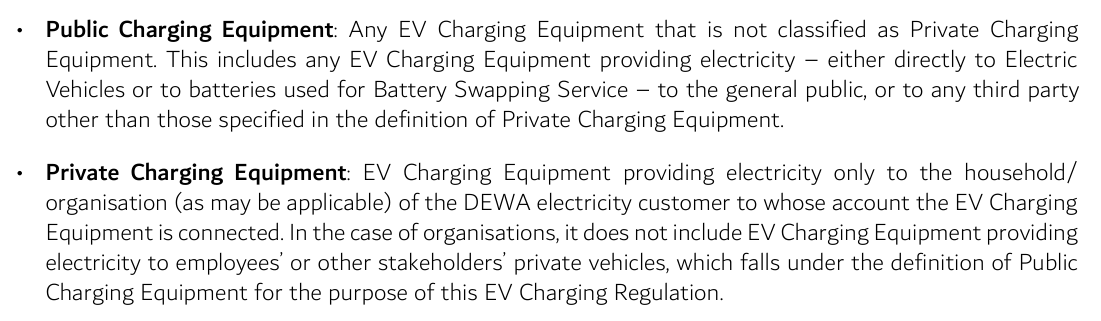
Two consequences follow. First, Article 7(2) forbids using household chargers or other private equipment to provide electricity to the public or to any third party outside that definition. A home charger is for your household, not a small paid charging point. Operating public charging infrastructure is a separate matter that needs a CPO licence from DEWA or controlling equity participation by DEWA (Article 7(1)), and it is outside the scope of a villa project. Second, Article 4(3) gives DEWA the power to set the technical requirements and procedures for connecting both public and private equipment, which is why the technical regulations below apply to your charger too.
One practical question deserves an early answer from your consultant. If an annex is occupied by a different household, or has its own DEWA account, the definition ties private equipment to the household of the customer whose account feeds it. DEWA's documents do not discuss annexes, so ask your DEWA-enrolled consultant how the definition applies to your layout before you decide where the charger sits.
Who installs a home EV charger and what approval is needed?
DEWA's consumer FAQ says a home charger can be installed by a third party behind the customer's meter like other home appliances, DEWA-approved electrical contractors should be used, and home charging is billed on the normal DEWA bill at standard residential rates. The technical regulations describe how the electric connection process starts: approach a DEWA-enrolled consultant or contractor, apply for a Building No-Objection Certificate for electricity in line with DEWA's procedures, and apply for an electricity connection as per DEWA's procedures (clause 7.3, page 12).
Using an enrolled consultant or contractor protects you: they work within DEWA's procedures, DEWA's FAQ advises DEWA-approved electrical contractors, and the technical regulations start the process with a DEWA-enrolled consultant or contractor (clause 7.3). Article 8(6) of the regulation refers to "the applicable procedures" for DEWA's approval of private equipment. The documents we reviewed do not name a separate home-charger form, so your consultant confirms which application route applies to your villa and project. If your annex or extension is already going through the DEWA electrical application, ask whether the charger can be included in the same drawings. Our guide to the DEWA connection steps for an annex explains that application and the documents behind it.
Home EV charger installation in a Dubai villa: DEWA's technical sheet for AC chargers
Clause 5.1 of the Technical Regulations is a specification table for AC EV supply equipment. It describes what a compliant charger unit looks like. The rows that matter to an owner are below, followed by the original table.
| Item | What clause 5.1 says |
|---|---|
| Supply | Single phase or three phase (1P or 3P + N + PE), 230 V or 400 V ± 10 %, 50 Hz. |
| Charge points per unit | Up to 2. |
| Maximum current | Up to 32 A per phase. |
| Nominal power | Up to 22 kVA per charge point. |
| Connector | IEC 62196-2 Type 2. |
| Charging mode | Mode 3, with PWM control according to IEC 61851-1. |
| Overcurrent protection | MCCB or isolator, 4-pole, 30 kA, with current breaking capacity. |
| Safety protection | RCD 30 mA, auto recovery, class A. |
| Place of installation | Indoor or outdoor. |
| Protection degree | IP54 / IK10. |
| Sound | Below 60 dB at 1 metre in all directions. |
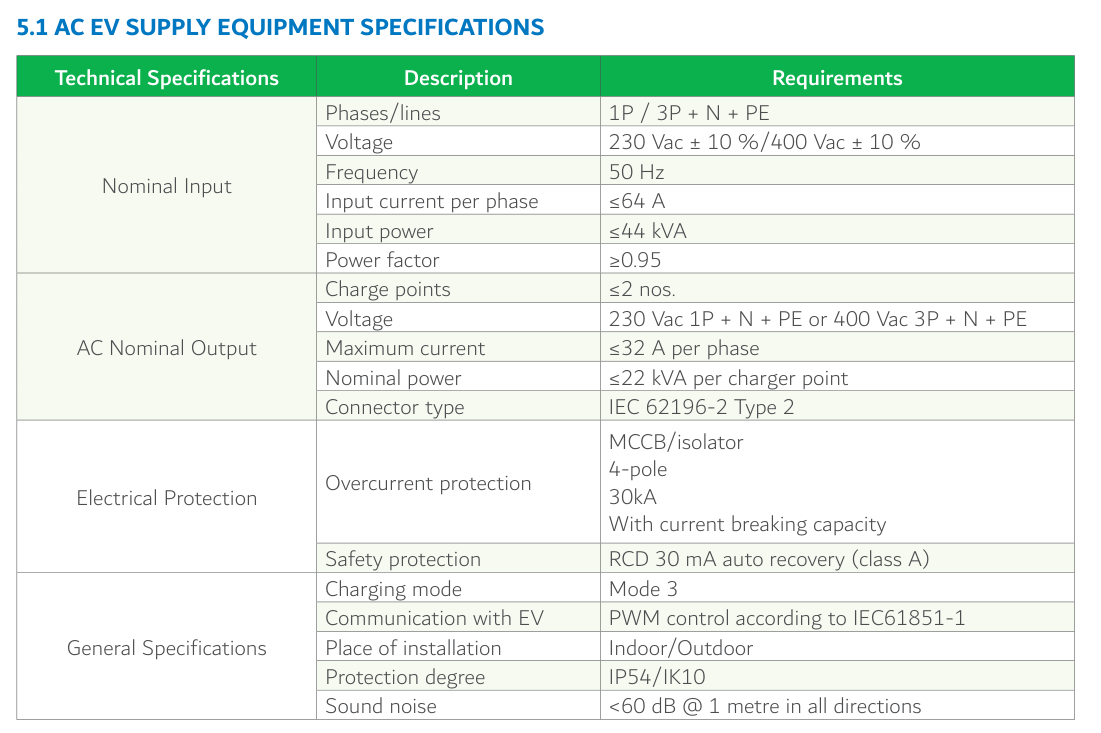
Read the table for what it is: a specification for the charger unit. The same table also lists nominal input limits for the unit (up to 64 A per phase and 44 kVA). None of this is a rule about the size of the breaker, the cable or the supply your villa needs. DEWA's documents do not state that, and it depends on the villa's existing load and the design, so it is for your engineer's load calculation and, where required, DEWA's review. For the ratings of an existing supply, see our guide to increasing the electrical load for a villa extension.
Clause 4.2 adds that the equipment must be able to operate at full capacity indoors or outdoors at a maximum ambient temperature of 55 °C and relative humidity up to 95 %, and the introduction to section 4 says outdoor equipment must withstand Dubai weather conditions. Ask your supplier to show these ratings on the data sheet for the model you choose.
Connector and charging mode: Type 2, Mode 3 and the extension-cord restriction
Clause 4.4 says that, due to safety concerns, Charging Mode 1 and Mode 2 cables used with extension cords are restricted for EV charging. DEWA explains why: extension cables can introduce overheating, increased resistance and potential electrical faults. In Mode 3 the charger is permanently connected to the supply and a control pilot signal runs from the charger to the car (the definition in the regulations' terms table, page 3). That is the mode in the AC table, and in practice it is the reason a fixed wall box is the usual answer for a villa rather than a long lead to a socket.
On connectors, the sources need careful reading. Clause 4.3 says private equipment for restricted use has no restriction on connector type as long as it meets DEWA's electrical requirements, while clause 4.4 says private and public equipment are exclusively equipped with Type 2 connectors for Mode 3, and the AC table lists Type 2. The practical advice is simple: choose a Mode 3 charger with a Type 2 socket, check with your consultant that the model satisfies DEWA's electrical requirements, and do not rely on adaptors or extension leads. DEWA's own wall box, described on its EV green charger page, is a 22 kW AC unit with a single Type 2 socket.
Protection on the charger circuit: RCD, MCCB and enclosure
DEWA's table asks for three kinds of protection on the equipment itself:
- Overcurrent protection: an MCCB or isolator, 4-pole, 30 kA, with current breaking capacity.
- Residual current protection: an RCD of 30 mA with auto recovery, class A.
- Enclosure: protection degree IP54 and impact rating IK10, for indoor or outdoor use.
Clause 4.5 adds a requirement that matters for the neighbourhood network: the charger connected to DEWA's grid cannot add distortion such as harmonics or flicker, and it must comply with the voltage fluctuation and flicker performance of IEC 61851-21-2. In practice, a reputable supplier documents this for the model. The protection devices in the villa's distribution board that feed the charger are part of the electrical design under BS 7671 and the Dubai Building Code, so your engineer sizes and coordinates them with the rest of the board.
Installation standard: IET Code of Practice, BS 7671 and Dubai Building Code G.5
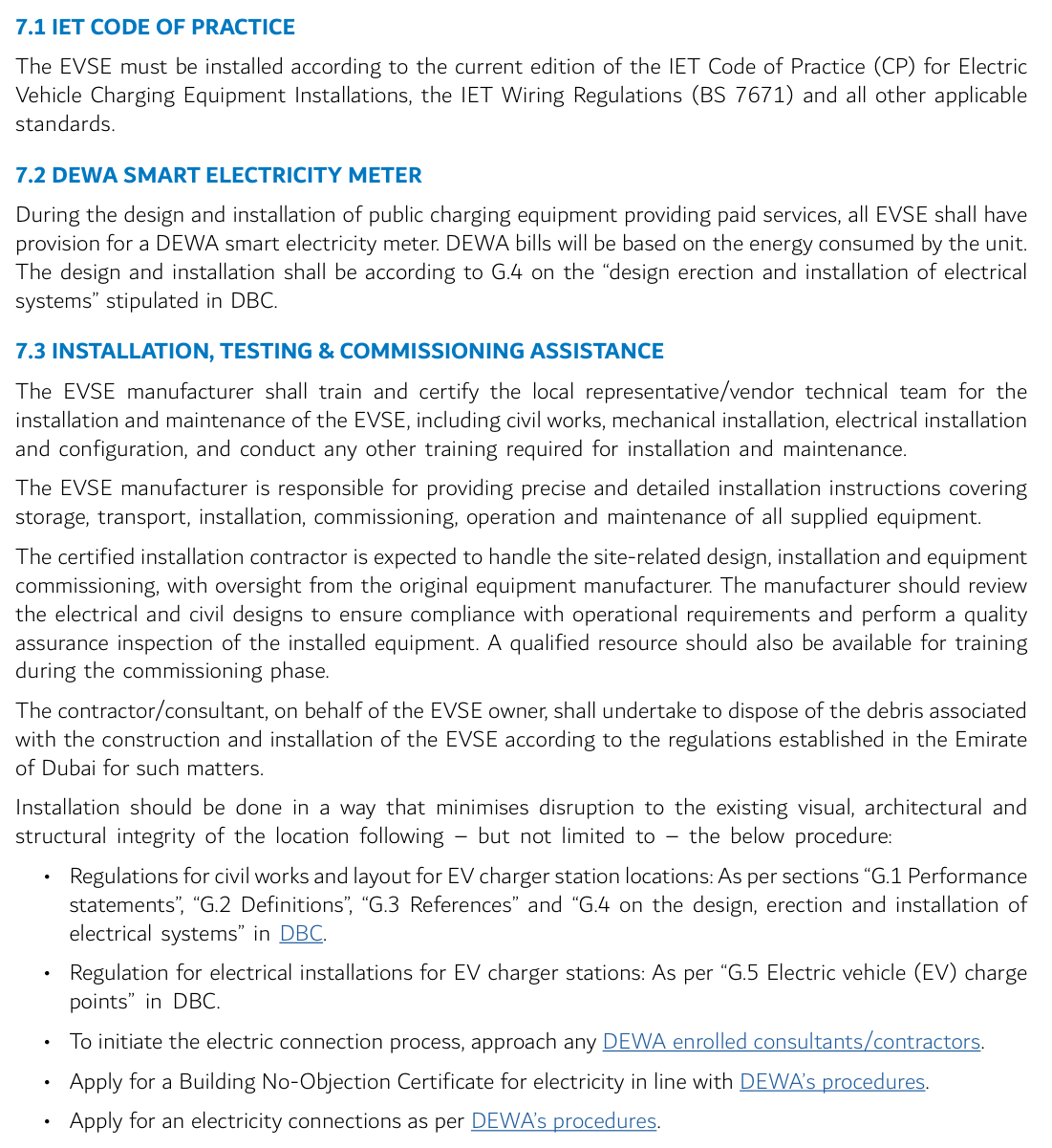
Clause 7.1 requires the equipment to be installed according to the current edition of the IET Code of Practice for Electric Vehicle Charging Equipment Installations, the IET Wiring Regulations (BS 7671) and all other applicable standards. Clause 7.3 points to the Dubai Building Code (DBC) for the rest: sections G.1 to G.4 for civil works, layout and the design, erection and installation of electrical systems, and section G.5, "Electric vehicle (EV) charge points", for the electrical installation of EV chargers.
This matches the way DEWA now splits its documents. DEWA's circular of 17 January 2022 (ref. DP-VP-CS-GEN-0008-2022) says the clauses of the DEWA Regulations for Electrical Installations that apply to electrical design are incorporated in the Dubai Building Code, mostly in Parts G and K, and that compliance with the Code is mandatory and verified when drawings are submitted for DEWA design approval. The same circular says the 2017 Regulations still carry the clauses on operation, periodic inspection and maintenance. In plain terms: design to the Dubai Building Code, and expect DEWA to check it at drawing approval. Our Dubai Building Code guide explains how the Code is organised for villa owners.
Planning a home EV charger inside an annex or garage project
This section is our engineering advice for owners, not a DEWA rule. A charger is easiest to plan when the walls are still open. Points to agree with your electrical engineer at the drawing stage:
- Cable route: the path from the distribution board to the parking position, through conduit that can be reached later, planned before tiling, landscaping or paving.
- Distribution board space: a spare way for the charger circuit and room for its protection devices, so the board does not have to be replaced later.
- Load schedule: the charger listed with the air conditioning, kitchen and other loads, because DEWA's application documents include a connected-load summary and MDB/SMDB schedules (see our annex connection guide).
- Earthing: the design follows BS 7671. DEWA's supply conditions for equipment (clause 4.2) list the LV earthing as TN.
- Charger position: indoors or outdoors, within the rating of the model (clause 5.1 allows both), and a place where the cable reaches the car port without being stretched or run through a doorway.
If the charger is part of a new annex, garage or extension, it belongs in the same drawing set as the rest of the electrical design, and the permit and inspection steps run alongside it. Our guides on the building permit for an annex and on inspections and the completion certificate show where the electrical steps sit in a project.
Adding a charger later: DEWA's rule on extensions and alterations
Many owners add a charger after the villa is occupied. The DEWA Regulations for Electrical Installations (2017 Edition) say in clause 1.14 (PDF page 20) that the consumer shall not make any extensions or alterations to the electrical installation without prior DEWA approval, and that an application for additional load or modification is made online for every project, large or small. Clause 1.7 (PDF page 10) asks that the proposed technical details of any electrical installation, large or small, new or additional, are submitted to DEWA for review and prior approval before work starts. Adding a dedicated charger circuit is an addition to the installation in ordinary terms, so raise it with your consultant before the cable is pulled. As noted above, DEWA's 2022 circular says the design clauses now sit in the Dubai Building Code while the 2017 edition still includes the applicable clauses on operation, periodic inspection and maintenance. The circular does not list clauses 1.7 and 1.14 either way, so your consultant confirms they still apply to a charger circuit and which application route is current.
Whether a charger needs an increase in the approved load depends on the existing load and the design, and DEWA's documents do not give a rule for a villa. Our guide on increasing the electrical load explains the additional-load route, and our guide to temporary construction power covers the supply during works.
Solar panels and an EV charger together
Owners who plan rooftop solar often want the charger on the same project. Our guide to Shams Dubai for villa owners explains the solar steps. On the charger side, the EV Charging Infrastructure Regulation deals with solar in Article 7(5) and 7(6), and those clauses are written for public charging equipment (Article 7(5) excludes its load when the maximum solar capacity is determined). The documents we reviewed do not say how a private home charger affects the solar capacity limit. Ask your consultant to deal with both in one load assessment and let DEWA's current Shams Dubai conditions decide.
What DEWA's documents do not say
- Fees: no fee for approving or connecting a home charger appears in the documents we reviewed. The licence charges in the regulation are for public operators and have nothing to do with a household charger. DEWA's FAQ states only that home charging is billed on your normal DEWA bill at standard residential rates.
- Load or breaker size for a villa: not stated. It follows from your villa's load calculation.
- A dedicated home-charger application form: not named in the regulation, which refers to the applicable procedures. Your consultant confirms the route.
- Annexes: not mentioned, so the question of an annex with its own household or account goes to your consultant and DEWA.
How Al Mustafa Contracting plans the charger with the build
We plan the charger circuit with the owner, the engineering office and our engineers as part of the electrical scope: the cable route and the board space are settled on the drawings, the installation follows the approved design and the DEWA-enrolled consultant handles the DEWA submissions. That keeps the charger from becoming a late change to finished walls or paving. Our contractor checklist shows what to agree in writing before you sign, and the cost guide explains what drives an annex budget.
Frequently asked questions
Does a home EV charger in a Dubai villa need DEWA approval?
Article 8(6) of DEWA's EV Charging Infrastructure Regulation says anyone deploying private charging equipment at their premises follows the applicable procedures to obtain DEWA's approval and complies with the EV Charging Technical Regulations. Your DEWA-enrolled consultant confirms the exact route.
Who can install the charger?
DEWA's consumer FAQ advises DEWA-approved electrical contractors, and the Technical Regulations say to start by approaching a DEWA-enrolled consultant or contractor.
What does DEWA require from an AC home charger?
Clause 5.1 lists Mode 3, a Type 2 connector, up to 32 A per phase and 22 kVA per charge point, a 4-pole MCCB or isolator, a 30 mA class A RCD and an IP54/IK10 enclosure.
Can I charge from a normal socket with an extension cord?
DEWA restricts Mode 1 and Mode 2 cables with extension cords for EV charging, citing overheating, increased resistance and potential electrical faults (clause 4.4).
Can I let neighbours or other people charge at my villa?
Article 7(2) forbids using household chargers to supply the public or any third party other than those covered by the Article 1 definition of Private Charging Equipment (the household or organisation of the account holder). Whether a tenant or an annex occupant counts is a question for your consultant and DEWA.
How much does DEWA charge for a home charger?
The documents we reviewed give no fee for a home charger. DEWA's FAQ says home charging is billed on the normal bill at standard residential rates.
What size supply or breaker does my villa need for a charger?
DEWA's documents do not state one. Your engineer calculates it from the villa's load and the charger model.
Need help planning a charger with your annex or extension?
We are happy to look at your plot and plans and explain how the charger fits the electrical design. Message us on WhatsApp, use the contact page, try the free cost calculator or browse our projects.
This article summarises official DEWA documents for owners and is not legal or engineering advice. The official DEWA documents and their current versions prevail.
Official sources
- DEWA: Electric Vehicles Charging Infrastructure Regulation for the Emirate of Dubai, Version 1.3, November 2025 (Articles 1, 4, 7 and 8)
- DEWA: EV Charging Technical Regulations, Version 1.0, May 2025 (clauses 4.2 to 4.5, 5.1, 7.1 and 7.3)
- DEWA: Regulatory Framework for EV Charging Infrastructure in the Emirate of Dubai
- DEWA: Dubai Building Code circular incorporating DEWA Regulations for Electrical Installations, 17 January 2022 (DP-VP-CS-GEN-0008-2022)
- DEWA: Regulations for Electrical Installations, 2017 Edition (clauses 1.7 and 1.14)
- DEWA: Consumer FAQs (home EV chargers)
- DEWA: EV green charger instructions
Planning your next project?
Talk to the Al Mustafa team for advice and a quotation for your project in the UAE.
Related articles
 17 November 2026Periodic Inspection of a Villa Electrical Installation in Dubai: Alterations, Labels and Upkeep After HandoverRead article
 15 November 2026Building an Annex or Majlis with MBRHE Support: A Practical GuideRead article