

16 min read
In this article
- VAT refund for UAE nationals in short
- Who is eligible for the VAT refund for UAE citizens?
- VAT refund for a new villa: the main residence
- What qualifies
- New items effective from 1 January 2026
- The deadline for a new villa
- Documents for the VAT refund on a new residence
- How to apply for the VAT refund on EmaraTax
- Common reasons a VAT refund request is delayed or rejected
- VAT refund for later additions: annexes, majlis and service blocks
- The general rule
- Additions that the FTA says can qualify
- Additions that typically do not qualify
- Service blocks and staff rooms: read the 2026 list carefully
- Planning with your contractor and consultant
- Frequently asked questions
- What is the deadline for the VAT refund for UAE nationals?
- Does the VAT refund cover a villa annex or extension?
- Is a maid's room, driver's room or garage refundable?
- How long does the refund take and what does it cost?
- Official sources
The VAT refund for UAE nationals building new residences returns the VAT you pay to the contractor, the consultant and the material suppliers when you build your own home, but only if the building, the person and the paperwork all meet the Federal Tax Authority's conditions. This guide follows the FTA's own VAT Guide VATGRH1 (June 2026) and its service page: who is eligible, which expenses count, the deadline, the documents, how to apply on EmaraTax, and a separate section on what happens when you add an annex or a service block later.
VAT refund for UAE nationals in short
- The scheme is for a natural person who is a UAE national and holds Family Data, building a new residence that will be used solely as the home of the applicant and the applicant's family (VATGRH1, sections 3.3 and 3.4.1).
- The request goes to the FTA through EmaraTax or the Maskan app, within 12 months of completion, counted from the earlier of the date the home is occupied or the date of the Building Completion Certificate (section 4.1).
- Only one request is accepted per residence, with two exceptions: retention payments, and an addition made later that is supported by a new completion certificate (section 3.1; FTA service page, FAQ 2).
- Applying is free. Processing takes 25 working days on the FTA service page and up to 20 business days in the guide, so plan for the longer one.
- The guide is not legally binding. The legal basis is Article 66 of the VAT Executive Regulation (Cabinet Decision No. 52 of 2017) under Federal Decree-Law No. 8 of 2017.
Who is eligible for the VAT refund for UAE citizens?
The conditions in the guide boil down to four points. All of them must be true for the request to be considered. The 12-month deadline is covered separately below.
- The applicant is a UAE national who is a natural person. A company cannot apply. The applicant must hold Family Data, the digital replacement for the Family Book since 2024 (section 3.3; Article 66(2)(a) of the Executive Regulation).
- The applicant owns or acquires the land and builds, or commissions the construction of, their own residence (section 3.1). The documents list asks for proof of ownership of the plot (section 5.1).
- The building is new and is a residence. The guide defines a residence as a newly constructed building, villas and townhouses included, used predominantly as a private home, with at least cooking facilities, washroom or bathroom facilities and sleeping quarters (section 3.2). Buildings registered for commercial use, such as hotel apartments, serviced apartments and guest houses, do not qualify.
- The use is solely residential. A building that will be leased to another person does not qualify. If the use changes after the refund, the owner must notify the FTA and may have to repay the refunded VAT (section 3.4.1 and the note in section 3.4.2; Article 66(5)). A small office or study used by the occupants does not change the residential character (section 3.2).
If several people own the property, one owner is authorised by a notarised power of attorney to request and receive the refund. The FTA lists a missing power of attorney among the common errors (section 5.3).
VAT refund for a new villa: the main residence
This section covers the usual case: you own a plot, appoint a licensed consultant and contractor, and build a new villa to live in. Our guide to building a villa in Dubai covers the construction side. Here is what the FTA says about the refund.
What qualifies
VAT may be recovered on two categories of expense (section 3.4.2; Article 66(6)):
- Building materials, meaning goods normally incorporated by builders in a residential building or its site, excluding furniture and electrical appliances.
- Services of contractors, including builders, architects, engineers and similar services necessary to complete the residence.
Goods count as incorporated when fixing or removing them needs tools or leaves the structure needing remedial work. The guide's examples of items that can be claimed include central air conditioning and split units, doors, fire alarms and smoke detectors, flooring other than loose carpets, kitchen sinks, work surfaces and fitted cupboards, sanitary and shower units, window frames and glazing, and wiring embedded in the structure. Appendix 1 adds light fittings, power points, lifts, solar panels, guttering, boundary fencing and supervisory services for the building.
Not refundable under Appendix 1: unfixed furniture, curtains and loose carpets, kitchen appliances such as fridges, dishwashers and ovens, audio equipment, CCTV, telephones, children's play equipment, and garden furniture, ornaments and sheds. Note that CCTV appears in this excluded list, while smart and security systems that are fixed and integrated within the residence as part of a complete system are eligible from 2026 (see below). The guide does not reconcile the two, so treat stand-alone CCTV as excluded and ask the FTA about an integrated system.
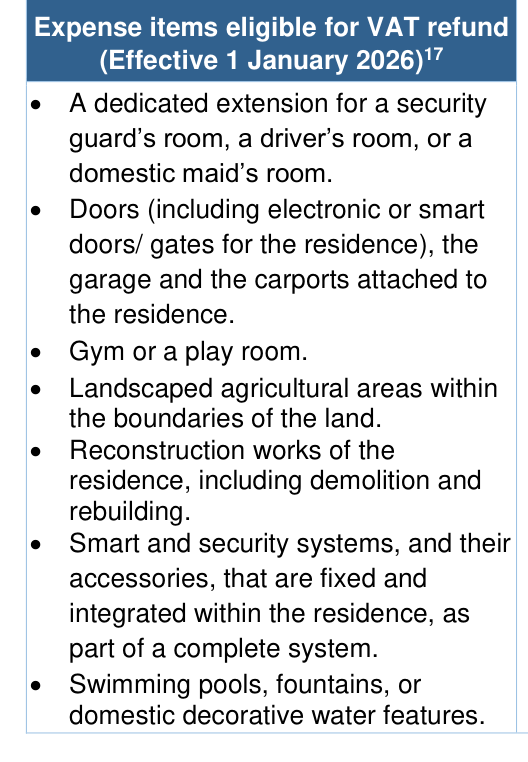
New items effective from 1 January 2026
FTA Decision No. 5 of 2026, issued on 2 June 2026 and effective from 1 January 2026, added items to the list. According to Appendix 1 of the guide, these are now eligible, when all the other conditions are met: a dedicated extension for a security guard's, driver's or domestic maid's room; doors, including electronic or smart doors and gates, and the garage and carports attached to the residence; a gym or play room; landscaped agricultural areas within the boundaries of the land; reconstruction works including demolition and rebuilding; smart and security systems fixed and integrated within the residence as part of a complete system; and swimming pools, fountains or domestic decorative water features. The FTA's announcement of 9 June 2026 says these features must be an integral part of the new residence, built on the same plot and directly serving the main home, and that the initiative applies to all refund claims submitted on or after 1 January 2026, provided all criteria are met. So a home completed in 2025 is not excluded for that reason alone, but the conditions and the 12-month deadline still apply.
The deadline for a new villa
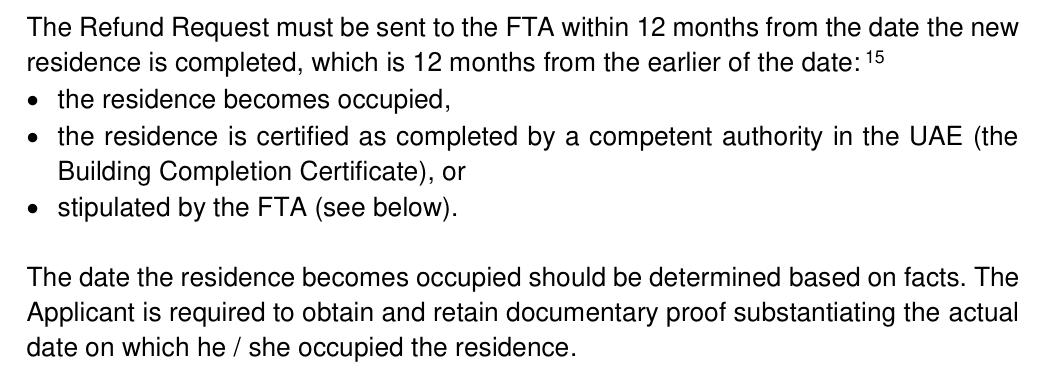
The request must reach the FTA within 12 months of completion. The 12 months run from the earlier of the date the residence becomes occupied and the date of the Building Completion Certificate (section 4.1; Article 66(3)). The FTA can also set another date. The occupancy date is decided on facts, so keep proof of the day you moved in. In limited cases (a reason that stops you filing on time such as military service or illness, a legal dispute over the residence, or pending technical works before the home is ready) the completion date moves to the date the event ended, at the FTA's discretion. The FTA Home Builders leaflet words this more simply: 12 months from the date of the Building Completion Certificate, with all expenses incurred before the request is submitted. The guide uses the earlier-of rule, so file as early as you can.
If you retain part of the contractor's payment until after the 12 months, say so in the first request. You may then file one further request within 6 months of the retention payment, or a combined one if it is filed within 6 months of the first retention payment (section 4.2). That is the second request that the one-request rule allows.
Documents for the VAT refund on a new residence
The guide (section 5.1) asks for these with the request:
- Emirates ID and Family Data (Family Sequence Number).
- The completion certificate, the building permit, the site plan and proof that you own the plot.
- A letter or certificate from your bank, stamped, showing the account holder's name, the bank's name and the IBAN.
- A power of attorney if someone applies for the owner, or court permission for minors.
Requests that meet the conditions go to a Verification Body appointed by the FTA, which does not charge UAE nationals. It may ask for the one-page architectural layout, the bill of quantities, the construction and consultancy contracts with addenda, variation orders, credit notes, a statement of any grant or loan, and the tax invoices with proof of payment (a "Paid" stamp or receipts).
The invoices are where most of the work is. The FTA wants a document titled "Tax Invoice" in the owner's full name, as shown on the permit and the completion certificate, with a unique sequential number and the supplier's, contractor's or consultant's Tax Registration Number, a clear description of the work and the correct VAT. The guide (section 5.1) says simplified tax invoices will not be accepted, but the FTA service page (FAQ 1) lists the details a simplified invoice must carry for refund purposes: the phrase "Tax Invoice", the full name of the owner or applicant, a reference number, the issue date, the supplier's name, address and TRN, the taxable amount, VAT and total, and a description of the goods or services. The two texts differ, so confirm with the FTA before relying on a simplified invoice, and ask suppliers for a full tax invoice. The guide also accepts, alternatively, an invoice that shows your full name, your signature and Emirates ID number as acknowledgement that the cost was incurred on your behalf, and the full plot number or street address, clearly marked as such. The service page adds that the invoice date must not be later than the latest document sent to the Verification Body. If an invoice is issued to a contractor or agent instead of the owner, it must say it is for the applicant's use, give the building details including the plot number, and the issuer must confirm it is not recovering the same input VAT. When you sign with your consultant and contractor, agree that every invoice is issued in your name with the plot number from the first one. See also the stages of villa construction and the completion certificate guide, because the certificate date starts your 12 months.
How to apply for the VAT refund on EmaraTax
All requests are made through EmaraTax or the Maskan app, which are synchronised. Maskan sign-in is through UAE PASS (FTA service page, steps). According to the FTA service page, the EmaraTax route is:
- Sign in to EmaraTax with UAE PASS, or register on the FTA website and activate the account.
- Open the User Profile screen and select Special Refunds.
- Click New Residence VAT Refunds, then New Refund Request.
- Complete the form, attach the documents and submit.
With Maskan you create a housing project, upload the tax invoices during construction (Maskan generates a bar code that suppliers can scan to link an invoice to your account) and complete the application after the Completion Certificate. The FTA acknowledges the request, gives a reference number and may ask for more information. After the Verification Body reports, the FTA notifies you whether the request is approved, amended or rejected. If you later find you claimed more than you were entitled to, you submit a voluntary disclosure (section 3.5; Article 10(2) of the Tax Procedures Law). Any grant or loan, for example MBRHE support (see our MBRHE villa guide), goes in the statement the Verification Body asks for.
Common reasons a VAT refund request is delayed or rejected
The FTA lists the common errors in section 5.3. It does not publish a full list of rejection grounds, so these are the points it names itself, plus the conditions above.
- Fields that do not match the supporting documents (Emirates ID, permit, bank letter), or a bank letter without letterhead and IBAN.
- No copy of the Municipality's completion certificate, or several owners without a power of attorney.
- Invoices that are simplified without the details the FTA requires, not in the owner's name, without a TRN, without proof of payment, or issued to a third party without the required statements.
- A filing after the 12 months, or a building that is not used solely as a residence, such as a leased one.
- Costs that are not eligible under Appendix 1, such as furniture and loose appliances.
VAT refund for later additions: annexes, majlis and service blocks
This is the part the guide treats most strictly, so here is what the FTA says. The guide tests anything built later by asking whether it is itself a "residence" (section 3.2), not whether it is attached to the villa.
The general rule
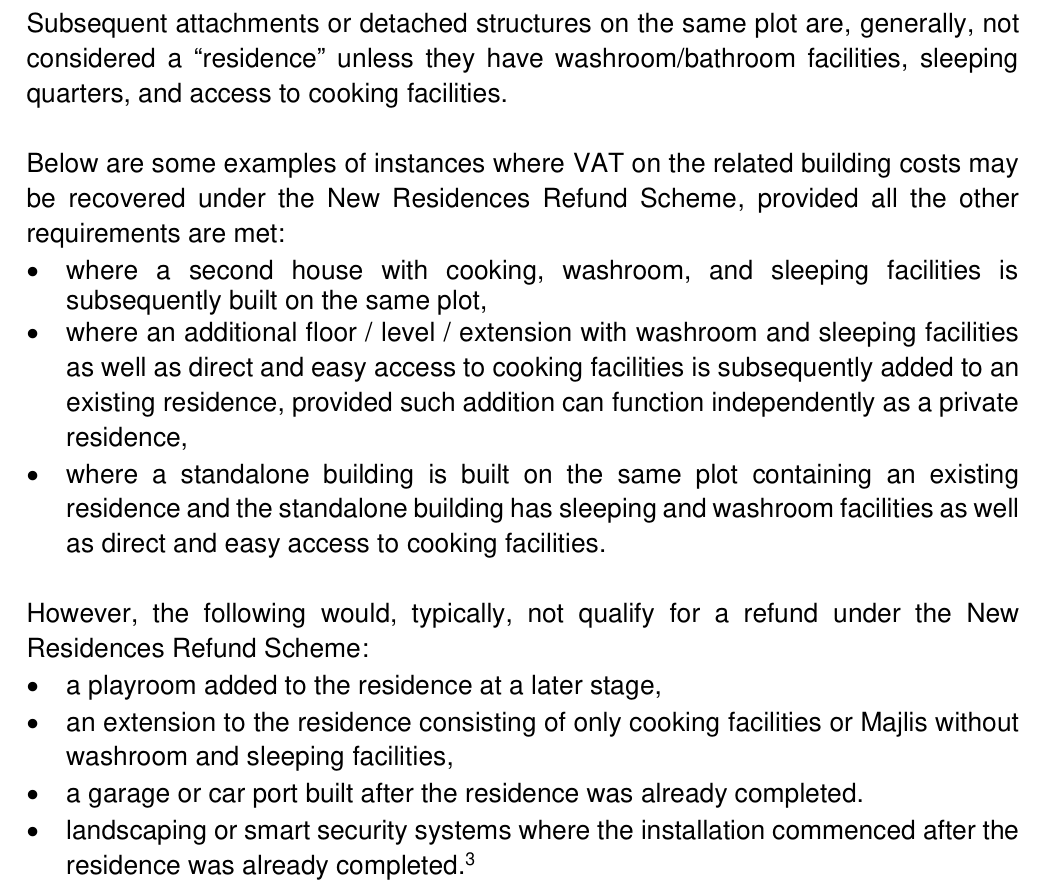
Subsequent attachments or detached structures on the same plot are generally not considered a residence unless they have washroom or bathroom facilities, sleeping quarters and access to cooking facilities. No refund is given for a further attached or detached structure unless it meets that definition (sections 3.2 and 3.4.2).
Additions that the FTA says can qualify
- A second house with cooking, washroom and sleeping facilities built later on the same plot.
- An additional floor, level or extension with washroom and sleeping facilities and direct, easy access to cooking facilities, added to an existing residence, provided it can function independently as a private residence.
- A standalone building on the same plot with sleeping and washroom facilities and direct, easy access to cooking facilities.
The FTA service page adds that a later addition supported by a new completion certificate can be claimed in a separate application. The service page does not say how the deadline is counted for such an addition, so confirm that with the FTA, and make sure the permit and certificate describe the addition clearly.
Additions that typically do not qualify
- A playroom added to the residence at a later stage.
- An extension consisting only of cooking facilities, or a majlis without washroom and sleeping facilities.
- A garage or car port built after the residence was already completed.
- Landscaping or smart security systems where installation started after the residence was completed.
Service blocks and staff rooms: read the 2026 list carefully
The June 2026 update reads differently from section 3.2 on some items. Appendix 1 lists, as eligible from 1 January 2026, a dedicated extension for a security guard's, driver's or domestic maid's room, the garage and carports attached to the residence, and a gym or play room. Section 3.2, in the same document, says a playroom added later and a garage or car port built after completion would typically not qualify. The guide does not explain how the two fit together, and it says VAT on the Appendix items may only be recovered when all the conditions in the guide are met.
What that means in practice:
- Our reading, not an FTA statement: a staff-room block, garage or gym built and invoiced as part of the original construction of the new residence fits the 2026 list most naturally.
- Our reading, not an FTA statement: a service block or annex built years later is tested by section 3.2 as a further structure. It qualifies as a residence only if it has sleeping quarters, washrooms and access to cooking facilities, and the service page ties a separate application to a new completion certificate for the addition.
- A later guard, driver or maid room, a garage or a playroom is in a grey area between section 3.2 and Appendix 1. We found no FTA text that settles it. Ask the FTA in writing before you build (Click to show the email address, or 800 82923), say whether the room is part of the original construction or built later, and keep the reply with your file.
- A majlis without washroom and sleeping facilities is named as typically not qualifying.
The easy way to protect a refund is to plan: put the rooms you know you will need into the first permit, so they are built, invoiced and certified together. If you already own a villa and are planning an annex, the planning rules are in our building permit guide for annexes, and the cost drivers are in the annex cost guide.
Planning with your contractor and consultant
The refund is claimed by you, but a smooth claim is built during construction: your full name and the plot number on every tax invoice, a receipt or Paid stamp for each payment, and the permit, contracts, bill of quantities and variation orders kept together. If you want a team that plans a villa or annex with the permit and the paperwork in mind, see our villa construction company in Dubai and annex construction contractor services, or write to us through the contact page.
Frequently asked questions
What is the deadline for the VAT refund for UAE nationals?
12 months from the earlier of the date the residence is occupied and the date of the Building Completion Certificate. Retention payments have their own 6-month window.
Does the VAT refund cover a villa annex or extension?
Only if the addition is itself a residence, with sleeping quarters, washrooms and access to cooking facilities. A majlis without washroom and sleeping facilities, or a kitchen-only extension, typically does not qualify. A later addition with a new completion certificate can be claimed in a separate application.
Is a maid's room, driver's room or garage refundable?
Appendix 1 of the June 2026 guide lists a dedicated extension for a guard's, driver's or maid's room, and the attached garage and carports, as eligible from 1 January 2026, subject to all conditions. Section 3.2 says a garage built after completion typically does not qualify, so confirm with the FTA before building one later.
How long does the refund take and what does it cost?
The service is free. The FTA service page gives 25 working days from a complete application, and the guide says up to 20 business days.
This article summarises official Federal Tax Authority documents for homeowners. It is not tax or legal advice. The FTA's website and the legislation in force remain the reference, and rules can change without notice.
Official sources
- FTA VAT Guide VATGRH1: VAT Refund for UAE Nationals Building New Residences (June 2026)
- FTA service page: VAT Refund for UAE Nationals Building New Residences
- FTA page: UAE Nationals, Building New Residences
- FTA news, 9 June 2026: expanded scope of eligible expenses
- FTA Home Builders leaflet
- Article 66 of Cabinet Decision No. (52) of 2017 (VAT Executive Regulation) under Federal Decree-Law No. (8) of 2017 on Value Added Tax, and FTA Decision No. (5) of 2026, as cited in the guide.
Planning your next project?
Talk to the Al Mustafa team for advice and a quotation for your project in the UAE.
Related articles
 17 November 2026Periodic Inspection of a Villa Electrical Installation in Dubai: Alterations, Labels and Upkeep After HandoverRead article
 15 November 2026Building an Annex or Majlis with MBRHE Support: A Practical GuideRead article