


15 min read
In this article
- Engineering consultancy in Dubai in short
- What an engineering consultancy office is under Dubai law
- Registration: who may call itself an engineering office
- Classification: what each class may design and supervise
- What the consultant does for you: design, permit and supervision
- Responsibilities and limits for the office
- Supervision: what DM inspects and what the consultant covers
- What owners should check before hiring an engineering consultancy office in Dubai
- Related guides and services
- Frequently asked questions
- What is an engineering consultancy office in Dubai?
- Who regulates engineering consultants in Dubai?
- How are engineering consultancy offices classified in Dubai?
- Can a consultancy office also be the contractor?
- Do I need a consultant for a villa annex or majlis?
- What should be in the consultancy contract?
- How long must the consultant keep my project records?
- Need help with design and permit?
- Official sources
Engineering consultancy in Dubai is a registered, classified activity: an office may design and supervise only what its Dubai Municipality class allows, through engineers who are themselves registered. This guide explains, from the official documents, how engineering consultancy offices are registered and classified, what each class may take on, what the office must do for you, and what an owner should check before hiring.
Engineering consultancy in Dubai in short
- Law No. (14) of 2025 regulates engineering consultancy activities across the emirate, including free zones and special development zones. It has been in force since April 2026 (six months after its publication in Official Gazette No. 741 of 7 October 2025), replaced Local Order 89 of 1994, and the one-year adjustment period for existing offices is still running (art. 23, 25 and 26).
- Nobody may practise or advertise as an engineering office without a trade licence and an entry in the DM register, and no one in Dubai may contract an unlicensed, unregistered firm for engineering consultancy (art. 5).
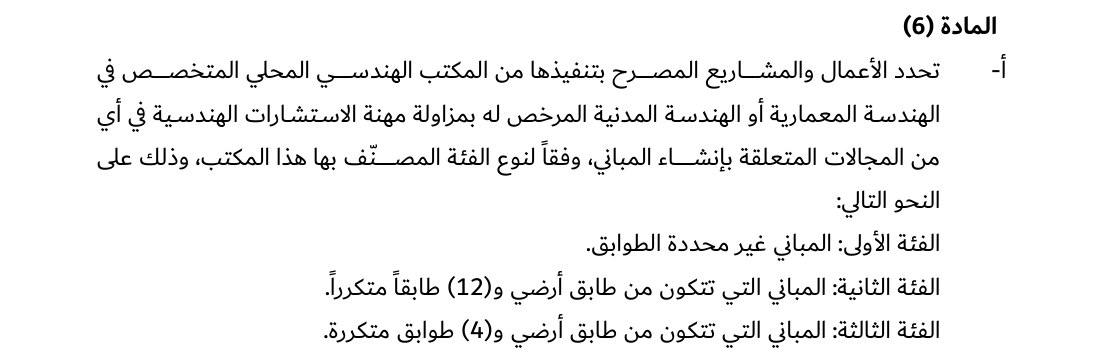
- Each office is classified. The published class bands, which as far as we know stay in force until DM issues its updated system (art. 25(b) and 6(4)), are tied to building height: class 3 up to ground plus 4 floors, class 2 up to ground plus 12, class 1 unlimited (decision 255 of 2021, art. 6).
- The office does the contracted work itself with its own technical staff, signs a consultancy contract with the owner before providing services, and supervises the contracted works continuously (Law 14, art. 17).
- Official registration fees are set by decision of the Executive Council Chairman (art. 19), so this guide quotes none.
What an engineering consultancy office is under Dubai law
Law 14 of 2025 defines engineering consultancy activities as those linked to fields such as architectural, civil, electrical, electronic, mechanical, mining, geological, coastal, petroleum and chemical engineering (art. 2). An engineering office is a firm or sole establishment entered in the register and allowed to practise one or more of these activities. The register is an electronic file kept by Dubai Municipality for each office: its permitted activity, its class and its technical staff (art. 2 and 6).
The law applies to everyone practising these activities in the emirate, including special development zones and free zones such as DIFC (art. 4). It cancels Local Order 89 of 1994, while earlier DM decisions, circulars and guides continue to apply to the extent they do not conflict with it, until replaced (art. 25). Existing offices and engineers have one year from the start of the law to adjust their status, extendable by the committee the law establishes (art. 23); with the law in force since April 2026, that year runs to about April 2027. That is why some documents cited below, such as decision 255 of 2021, were issued under the older order: they remain the published reference until DM publishes its updated classification system (art. 6(4)).
Registration: who may call itself an engineering office
The conditions to be entered in the register (art. 11) include a valid trade licence whose activity matches the registered consultancy activity, the technical staff required for that activity and class, a qualified office manager, and payment of the prescribed fees. A person entered as an engineering office may not be an owner, partner, manager or employee of a contracting firm or a building-materials trading firm, or an agent for their services, nor an owner or partner in, or manager or employee of, another licensed engineering office in the emirate, nor an employee of the authorities that license or supervise engineering consultancy (art. 11(2)). Article 17(15) adds that an office may not own or be a partner in more than one office.
- Office types (art. 10): a local office; a branch of an office from another emirate with at least three years of continuous experience; a branch of a foreign office with at least ten years; a joint office (a local first-class office in partnership with experienced foreign offices); an opinion office; and an engineering audit office acting as a third party.
- Engineers: an office may not use anyone as an engineer unless that person is registered and holds a professional competency certificate (art. 5(c) and 17(4)). Circular 13-3-1 of 2021 adds that no engineer should work on design, audit, supervision or execution before the party checks the degree, the years of experience, registration with the Engineers Association and a pass in the Dubai competency exam.
- Manager: every office has a registered engineer as manager, whose speciality suits the office's activity; the manager supervises the office technically and signs its contracts (art. 16).
- Term: registration lasts one year, renewable, with the renewal request submitted within 30 days of expiry; it may follow the trade licence period where DM allows (art. 13).
Classification: what each class may design and supervise
DM classifies each office in the category it qualifies for under the classification system, and may reclassify it if the criteria are lost (art. 15). An office may practise only within its permitted activity and its own class or a lower one (art. 15(c)). Decision 255 of 2021 sets the bands for architectural and civil offices in building construction:
| Class | Buildings | Minimum core engineers (table 2) |
|---|---|---|
| 1 | Unlimited floors | 5: two architects and three civil engineers, 5 to 10 years of experience |
| 2 | Ground + 12 | 3: one architect and two civil engineers, 5 to 7 years |
| 3 | Ground + 4 | 2: one architect and one civil engineer, 5 years each |
The table's notes add that all engineers must be members of the Emirates Engineers Association and pass DM's technical competency tests, that the full-time licence holder counts as part of the technical staff, and that DM (formerly the licensing committee under the old order) may raise the number of engineers as project areas grow. Article 6(b) lets DM allow an office to carry out a project in a higher class, provided the building is no more than three floors above the office's own class limit, to qualify it for promotion; a further such project may not be requested before the previous one is completed (see also Law 14, art. 15(c)), and article 5 lets a local office add a speciality by providing at least one specialised engineer for it.
For an owner, the practical reading is simple. A villa, annex or majlis is far below the class 3 limit, so any registered office whose activity covers architecture or civil engineering can be considered. The class matters more for larger buildings. Because DM is updating the classification system, ask the office to show its current registration and class rather than relying on an older table.
What the consultant does for you: design, permit and supervision
Circular 13-5-1 of 2023 asks owners to sign a written consultancy contract with the licensed engineering office before design and supervision work begins, and a written building contract with the contractor, in coordination with the office, before construction. It lists the minimum clauses: parties, scope, order of precedence of documents, responsibilities, fee, payment schedule, duration, handling of changes, delay consequences, termination, ownership of documents, notices and dispute resolution. The law makes the same point from the office side: an office may provide its services to others only after signing a consultancy contract with the project owner (art. 17(10)).
DM's guidance model engineering consultancy contract for a private residence (listed on DM's site as 13-5-1-2) shows what a full scope looks like:
- Study and design: site visit, preliminary study, preliminary design, final design with architectural, structural, electrical, plumbing, air-conditioning and fire drawings, each approved by the owner before the next stage.
- Permit: submitting to DM and the service entities, following up comments, obtaining the building permit and giving the owner a copy; the model also lets the owner authorise the office to sign for the permit on the owner's behalf (clause 4).
- Tender: tender documents, a list of licensed contractors proposed in consultation with the owner, comparison of offers and a recommendation.
- Supervision: reviewing the contractor's programme within 7 days, supervising execution through qualified engineers against the permit and approved drawings, progress reports every 15 days, checking materials and tests, replying to shop drawings and subcontractor requests within 7 days and to material samples within 15 days, checking payment claims, handling variation orders, final inspection and obtaining the completion certificate.
- Records and defects: keeping the drawings and calculations for at least 10 years and following defects during the maintenance period. The model also states the office's responsibility for collapse or defects threatening stability for ten years from handover, within its design and supervision scope.
It is a guidance model, so the actual terms are agreed between you and the office. Its sample fee clauses (clauses 6 and 7) use a percentage as the fee basis: 2% of the contract value when it is signed with the contractor for study, design, tender and permit, and 3% of the actual project value for supervision; treat these as a reference, not a tariff.
Responsibilities and limits for the office
Article 17 of Law 14 lists what an office must do. The points that matter most to an owner:
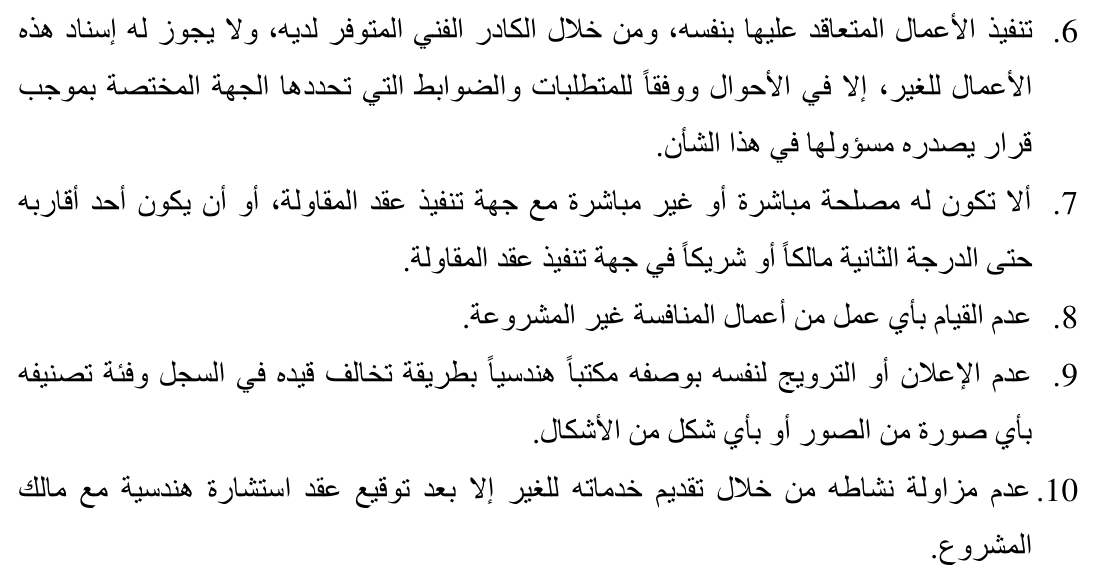
- do the contracted work itself, through its own technical staff, and not assign it to others except as DM's decisions allow (item 6);
- have no direct or indirect interest in the contractor carrying out the works, and no relative to the second degree who owns or partners in it (item 7);
- not enter consultancy contracts only to earn commissions without actually doing the work (item 12);
- not reuse a design prepared for one client for another without the first client's written consent (item 14);
- tell DM immediately about changes to the project and about violations or errors on it, and allow DM staff to enter the site and see the records (items 16 and 17);
- not include clauses in the owner's contract that relieve it of its duties (item 21);
- supervise the contracted works continuously for the whole execution period (item 22);
- keep contract records, drawings and documents for at least ten years from the completion certificate or the end of the contract (item 13).
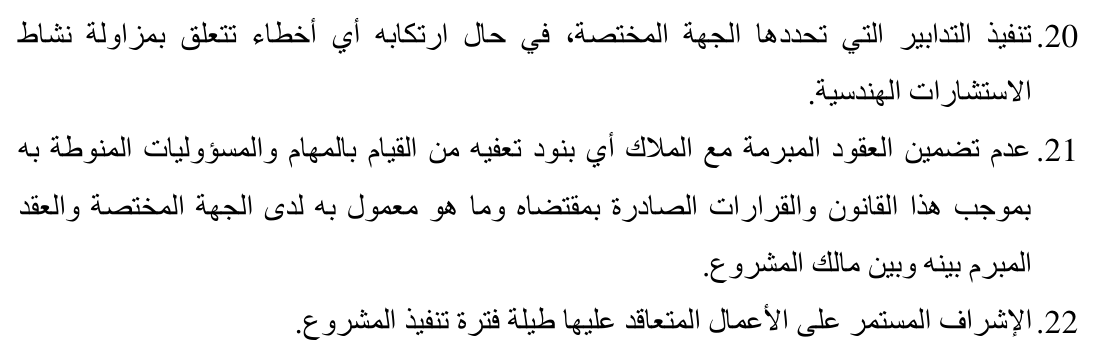
Other DM documents attach responsibility to the consultant in specific moments. Circular 3-7-1 makes the consultant fully responsible for any conflict or violation in modification drawings submitted during execution, circular 11-2-1 makes the contractor and the supervising consultant jointly responsible for errors after the building-marks certificate, and circular 13-4-1 asks both not to assign works to unlicensed subcontractors. The law's measures for breaches are graduated: a fine, suspension for up to one year, a lower class, or removal from the register (art. 20). That is part of what keeps the sector reliable for owners.
Supervision: what DM inspects and what the consultant covers
DM's own inspection of buildings in execution, villas included, is limited to the high-risk stages in its matrix: the foundation pouring stage, the structure stage and the completion stage (circular 13-3-1). The days in between are covered by the supervising consultant, who also submits periodic inspection reports through Dubai BPS where the permit has a consultant (circular 11-6-1). Our guide to Dubai Municipality inspections and the completion certificate covers the DM stages.
Whether your permit requires a supervising consultant depends on the project. For permits that do not require appointing an engineering office, decision 275 of 2024 has the owner take the office's place in the completion-certificate procedures (art. 12(5)); the building permit guide explains how this looks for an annex or majlis. Your engineer confirms what applies in Dubai BPS.
What owners should check before hiring an engineering consultancy office in Dubai
- Trade licence: valid, with an activity that matches engineering consultancy.
- DM registration and class: ask to see the registration and the class, and check that the class suits your building.
- Named engineers: registered, with competency certificates, and a registered engineer as manager.
- Independence: the office has no interest in the contractor, is not linked to another licensed office, and its registrant is not employed by a licensing or supervising authority (art. 11(2), 17(7) and 17(15)). Law 7 of 2025 allows turnkey design, build and supervision contracts for the project types DM specifies, so ask which route applies to yours. At Al Mustafa, permit drawings are prepared by a DM-registered engineering office and we build to the approved drawings.
- Written contract: scope, stages, fee and timeline, as circular 13-5-1 asks. Compare it with the DM model engineering consultancy contract.
- Track record: DM evaluates engineering offices annually and publishes results as open data at the end of each year (circular 13-1-2). Offices rated five stars are announced on DM's website and in Dubai BPS (circular 13-1-3), and the owner's opinion counts for 20% of the evaluation (circular 13-1-7), so honest feedback helps the sector.
If you need to change the office during the works, decision 275 of 2024 asks for the owner's declaration and a technical report on the stage reached. The replacement must be licensed with a class not lower than the building requires, a new permit is issued in its name after fees, and it cannot start before that permit. If the outgoing office does not consent, DM notifies it and it replies within five working days. Our guide to approved materials and contractors covers the contractor side, and the contractor checklist helps you agree the building contract.
Related guides and services
Read how the permit works in our building permit guide, which design rules apply in the Dubai Building Code guide, and what happens if work was done without a permit in violations and fines. For planning and building your annex, see our annex design in Dubai and annex construction contractor in Dubai services, the services page and the cost guide.
Frequently asked questions
What is an engineering consultancy office in Dubai?
A firm entered in Dubai Municipality's register that is allowed to practise engineering consultancy activities, with a class and registered technical staff (Law 14 of 2025, art. 2 and 10).
Who regulates engineering consultants in Dubai?
Dubai Municipality operates the register, classification and competency certificates, together with the competent authorities and a committee for regulating and developing engineering consultancy (Law 14 of 2025, art. 6 to 9).
How are engineering consultancy offices classified in Dubai?
By class. The published bands for building construction are class 1 unlimited floors, class 2 ground plus 12 and class 3 ground plus 4 (decision 255 of 2021). DM is updating the system, so ask to see the office's current class.
Can a consultancy office also be the contractor?
An engineering office registrant may not be an owner, partner, manager or employee of a contracting firm or a building-materials trading firm, nor of another licensed engineering office (Law 14, art. 11(2)). Law 7 of 2025 allows turnkey contracts for project types DM specifies, so confirm which applies.
Do I need a consultant for a villa annex or majlis?
The design and permit stage normally involves a licensed engineering office. A supervising consultant during execution may not be required for small projects; your permit request in Dubai BPS shows what applies.
What should be in the consultancy contract?
Circular 13-5-1 lists parties, scope, responsibilities, fee, payment schedule, duration, change handling, delay consequences, termination, document ownership, notices and dispute resolution.
How long must the consultant keep my project records?
At least ten years from the completion certificate or the end of the consultancy contract (Law 14, art. 17(13)).
Need help with design and permit?
We are happy to look at your plot and idea and explain the path. Message us on WhatsApp, use the contact page, try the free cost calculator or browse our projects.
This article summarises official Dubai Municipality documents for owners. The official DM website and the current versions of the documents prevail.
Official sources
- Law No. (14) of 2025 regulating engineering consultancy activities in the Emirate of Dubai and Law No. (7) of 2025 on regulating contracting activities
- Administrative Decision No. (255) of 2021 amending certain provisions of Administrative Decision No. (51) of 1998 issuing the executive regulation of Local Order 89 of 1994 and Administrative Decision No. (275) of 2024 on changing engineering offices and contractors and issuing completion certificates
- Circular 13-5-1 (2023): guidance contracts and DM model engineering consultancy contract (listed as 13-5-1-2)
- Circular 13-3-1 (2021), Circular 13-4-1 (2021), Circular 13-1-2 (2022), Circular 13-1-3 (2023) and Circular 13-1-7 (2025)
- Circular 3-7-1 (2021), Circular 11-2-1 (2021) and Circular 11-6-1 (2021)
Planning your next project?
Talk to the Al Mustafa team for advice and a quotation for your project in the UAE.
Related articles
 17 November 2026Periodic Inspection of a Villa Electrical Installation in Dubai: Alterations, Labels and Upkeep After HandoverRead article
 15 November 2026Building an Annex or Majlis with MBRHE Support: A Practical GuideRead article