

15 min read
In this article
- 3D printing in Dubai construction in short
- The Dubai 3D printing strategy and the 25% target
- Which Dubai Municipality rules apply to 3D printed buildings?
- Who can do 3D printing construction in Dubai?
- How to get approval for a 3D printed building in Dubai
- 1. Initial consultation with DM
- 2. Approval of the building system
- 3. Project documents
- 4. The request in Dubai BPS
- 5. Review, amendments and approval
- 6. Building with structural audits
- Materials, mixes and testing for 3D printed concrete
- Site safety and engineer supervision
- Quality warranty and insurance
- What 3D printing means for villa annexes, majlis and small buildings
- Related services
- Frequently asked questions
- Is 3D printing allowed for buildings in Dubai?
- Who approves a 3D printed building in Dubai?
- What are the Dubai Municipality requirements for 3D printed buildings?
- Can a villa annex or majlis be 3D printed in Dubai?
- How long does the 3D printing permit take?
- Where is the first 3D printed building in Dubai?
- Need help with design and permit?
- Official sources
A 3D printed building in Dubai is not a free-for-all experiment: Dubai Municipality (DM) regulates 3D printing in construction through a decree, an administrative decision and a technical guide, and every printed building still goes through the normal building permit. This guide explains the DM requirements and approval route for 3D printed buildings from the official documents: who is allowed to do the work, how the printing system and the concrete mix are approved, how a project is submitted, what happens on site, and what it means today for villa annexes, majlis and other small buildings.
3D printing in Dubai construction in short
- Dubai set a goal of building 25% of its new buildings with 3D printing by 2030. It comes from the Dubai 3D Printing Strategy (April 2016) and is written into Decree 24 of 2021.
- Nobody may carry out or advertise 3D printing construction work without a prior DM permit and registration. The decree applies across the emirate, including free zones and special development zones.
- Three parties need permits under Administrative Decision 217 of 2023: the engineering office, the contractor and the factory that supplies the printing mix. Each has minimum engineering staff.
- The concrete mix may only come from a factory certified by the Dubai Central Laboratory, and the printing system itself is approved by DM before a project is licensed.
- The project is then submitted through Dubai BPS with the building type set to 3D printing technology, reviewed by the competent authority's committees (DM's, outside free zones), and inspected at structural audit stages that include the start and end of printing.
The Dubai 3D printing strategy and the 25% target
According to the UAE government portal, Sheikh Mohammed bin Rashid launched the Dubai 3D Printing Strategy in April 2016 to make Dubai a leading hub for the technology by 2030. It covers three sectors, construction, medical products and consumer products, on five pillars: infrastructure, legislative structure, funding, talent and market demand. Its key construction goal is that 25% of Dubai's buildings are based on 3D printing technology by 2030.
In May 2016 the Dubai Media Office reported the opening of the Office of the Future at the Emirates Towers premises, up to 250 m², printed in 17 days and installed in two, and presented as the first 3D printed office building in the world.
Decree 24 of 2021 turned the ambition into a legal framework. Its objectives include lowering cost and construction time, reducing waste, regulating the technology across the emirate and raising the share of printed buildings gradually towards the 25% target (Article 3). DM describes its role as publishing standards, training engineers, issuing permits, monitoring projects and certifying the plants that produce 3D printing mixes.
Which Dubai Municipality rules apply to 3D printed buildings?
| Document | What it covers |
|---|---|
| Decree 24 of 2021 | Scope, the permit and registration requirement, duties of the engineer and the contractor, the 25% target |
| Administrative Decision 217 of 2023 | Permit conditions and procedure, minimum staff, structural design, factories, mixes, warranty |
| 3D Printing Guide, first edition, June 2024 | Design, materials and tests, the permit route, site safety, factory certification |
| Dubai Building Code | The structural, architectural and services design rules that still apply to a printed building |
The guide itself notes that it does not guarantee a building permit for a particular project. It gives the general guidance DM uses to evaluate and license. It also says the guide and the administrative decision are read together. For the code that sits underneath, see our Dubai Building Code guide.
Who can do 3D printing construction in Dubai?
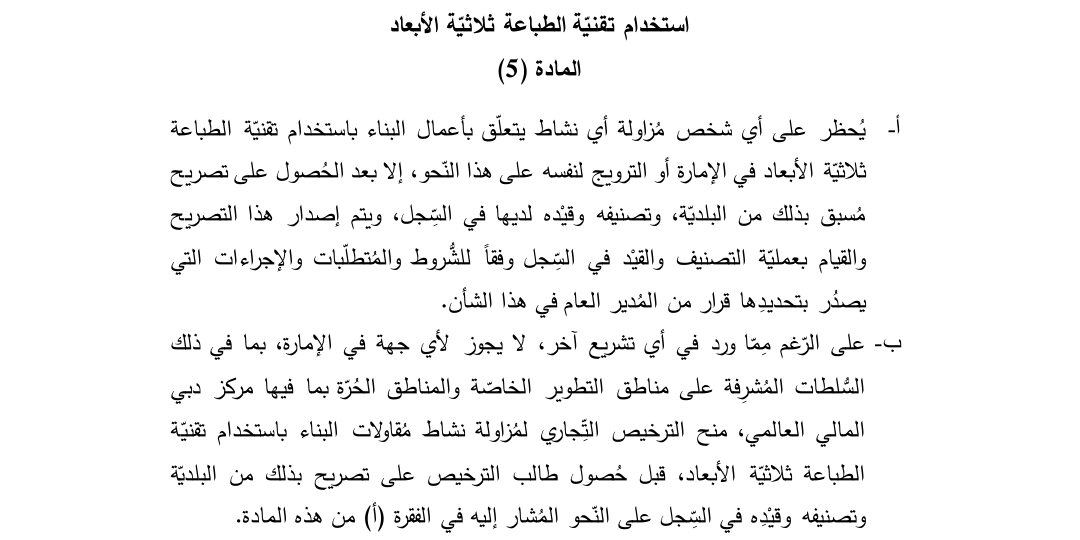
Article 5 of the decree prohibits any person from practising an activity connected with building works using 3D printing in the emirate, or promoting themselves that way, without a prior DM permit, classification and registration in DM's register. It adds that free zone and special development zone authorities may not grant a commercial licence for 3D printing contracting before the applicant holds that DM permit. A main contractor may not carry out 3D printing works except through a classified 3D printing contractor, unless the main contractor is itself licensed and classified for this activity as a sub-specialty.
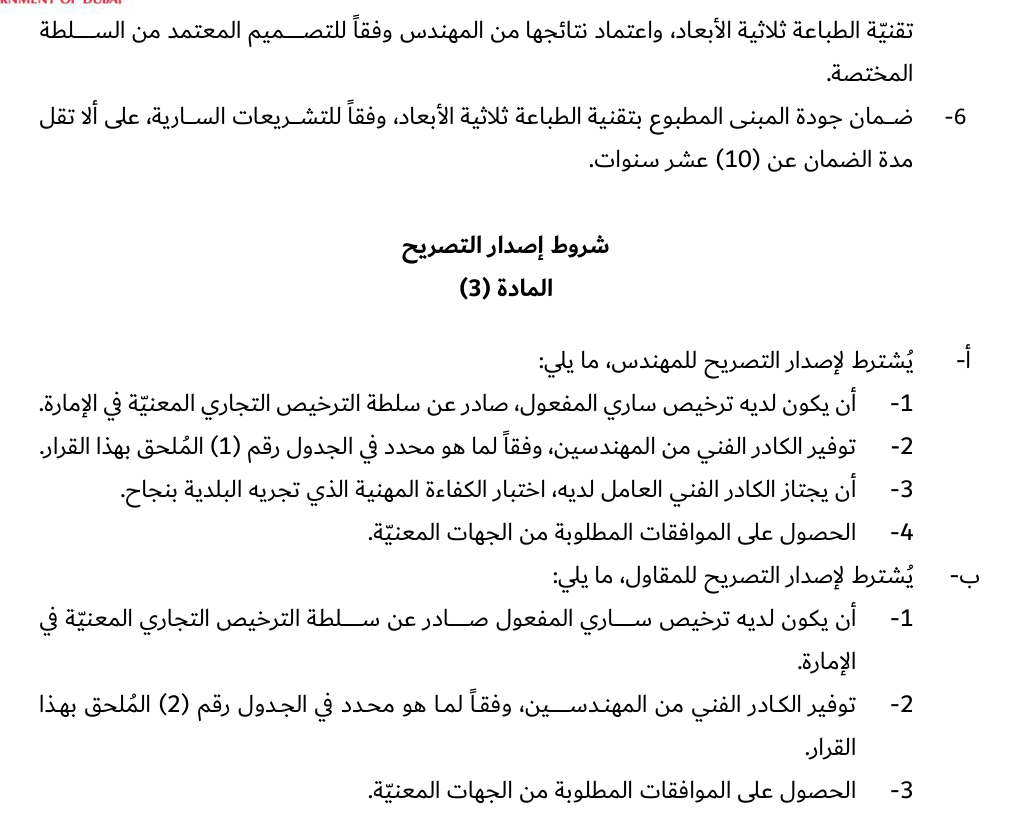
Administrative Decision 217 of 2023 sets the conditions for each permit. In every case the applicant needs a valid trade licence from the relevant licensing authority, the engineering staff listed in the decision's tables, and the approvals required by the relevant entities.
- Engineering office: at least one civil engineer and one architectural engineer, each with a bachelor's degree and five years' experience, whose staff pass the professional competency test run by DM.
- Contractor: at least one civil engineer with a bachelor's degree and five years' experience.
- Factory: at least one civil engineer with a bachelor's degree and three years' experience.
DM studies the application, may ask for more information, and issues its decision within five working days of the application being completed. The permit is valid for one year and is renewable, with the renewal request made within 30 days of its expiry date at the latest (Article 5); renewing early is wise. Engineers and contractors are classified within their specialty by the licensing committee. The guide explains that engineers are approved and registered through the Dubai Engineering Qualification (DEQ) system, and that DM's register of consultants and contractors is maintained by its qualification section (Guide Annex A and B).
How to get approval for a 3D printed building in Dubai
Annexes B and C of the DM guide describe the route. It is the normal building permit process with extra steps for the printing system.
1. Initial consultation with DM
The project team discusses the project with DM and the relevant entities to understand the rules specific to 3D printing, by meetings or correspondence.
2. Approval of the building system
DM's research and building systems section approves the 3D printing system before the building permit procedures begin. The approval is issued to 3D printing contractors registered under the activity of constructing buildings with 3D printing. It covers the concept and method of the system, not one project, while structural drawings and calculations are reviewed again for each project. The application includes the company's licence and project list, key staff and operator training certificates, a description of the printer and method, detailed cross-sections of the printed elements, quality control procedures, test reports, and Dubai Central Laboratory conformity certificates for the printing mortar and the insulation materials. On performance it asks for U-value calculations for external walls and roofs, acoustic test reports and Dubai Civil Defence approval of the insulation materials.
3. Project documents
The engineering office prepares the architectural, structural, services and material documents. They must show clearly how the printing technology and the approved method are used. The architectural design follows the Dubai Building Code, as do the structural and the mechanical, electrical and plumbing design.
4. The request in Dubai BPS
The request goes through the same electronic building permit system as any new project. The guide says to add the building card details and choose 3D printing technology as the building type, then attach the documents and drawings and submit. Fees depend on the project type and size and are paid before construction starts (Guide Annex C, item 9), so we quote no figure. For the general permit steps, see our guide to the Dubai building permit for annexes and extensions.
5. Review, amendments and approval
The competent authority's committees (DM's, for the emirate outside free zones) review the documents against the Dubai Building Code, the planning rules and safety standards, including the structural, architectural, electromechanical and fire safety committees. Comments may require amendments or clarifications. Once the documents comply, the permit is issued, sometimes with conditions to follow during construction.
6. Building with structural audits
The contractor requests structural audit inspections before pouring foundations and slabs or shoring (as for a conventional building), before starting the 3D printing works, and after the printed elements are complete. Our guide to Dubai Municipality inspections and the completion certificate explains the usual stages.
Materials, mixes and testing for 3D printed concrete
The material is where the rules are most specific. Under Administrative Decision 217 the contractor may not use a printing mix unless the factory that prepared it holds a conformity certificate and conformity mark from the Dubai Central Laboratory, and the factory must show the mix stays within the approved proportions and meets the thermal insulation performance required by the emirate's regulations.
Section 6 of the guide adds engineering limits for the mix:
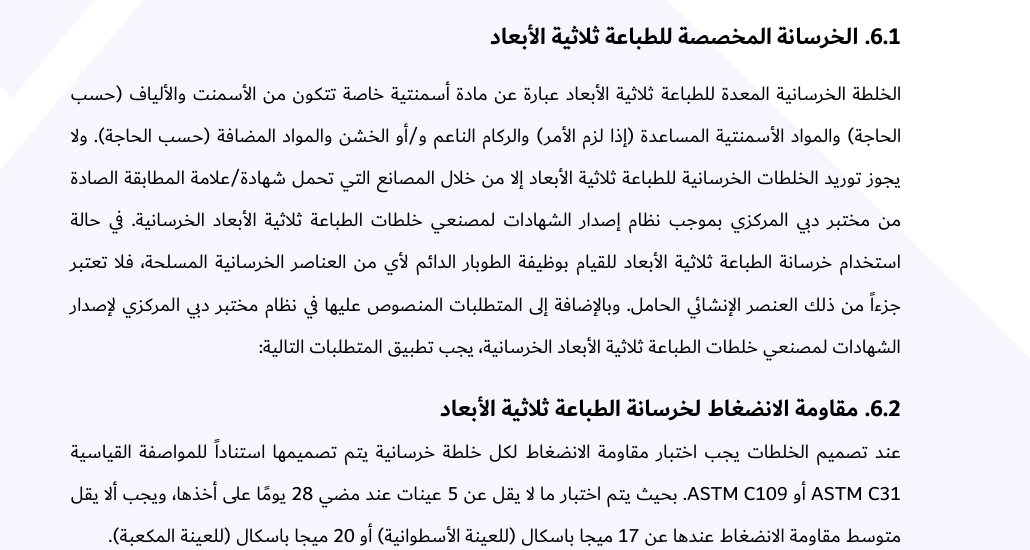
- A printing mix is a special cementitious material, which may contain fibres, supplementary cementitious materials, fine and coarse aggregate and admixtures, and it may be supplied only by factories carrying the Dubai Central Laboratory certificate or mark.
- Compressive strength is tested for every mix design on at least 5 samples at 28 days, and the average must not be below 17 MPa for cylinders or 20 MPa for cubes. Samples are also taken during printing, at least 5 per printed element.
- Shrinkage is tested on at least 3 samples per mix design, with the average strain at 28 days below 0.065% for mixes with fibres or aggregate above 1.25 mm, and below 0.05% for the others.
- Printed concrete used as permanent formwork for a reinforced concrete element is not counted as part of that structural element.
The factory certificate is valid for one year and is renewable subject to satisfactory periodic audits. If the mix must come from outside the emirate, the contractor needs to show it is not available in the local market or not sufficient, obtain DM approval before delivery, run tests proving the proportions and thermal performance, and, according to the guide, obtain an exemption letter from the Dubai Central Laboratory. On site the engineer must approve a trial mix, and test results must be kept on site.
Site safety and engineer supervision
Annex D of the guide sets the printing site rules. The contractor prepares a site plan, and a risk assessment and safety plan approved by the engineer, holds safety certificates for the printers and operators, and follows the manufacturer's manual. Weather is monitored daily, the site needs a wind gauge, and printing stops in heavy rain or when wind or vibration exceeds the manufacturer's limits. Excavation is not allowed within at least 3 metres of a printer, or the distance stated in the printer's guide, the printer floor must be firm and level, and hot work such as welding is not allowed nearby.
The engineer checks that the work matches the approved drawings, audits elements before pouring and after printing, and verifies material conformity certificates. A defect treatment method is approved by the engineer, reported to DM, and approved by DM if the defect affects structural safety. For general site rules see our site safety guide.
Quality warranty and insurance
Administrative Decision 217 requires a warranty on the quality of the printed building, in line with the legislation in force, of not less than 10 years (Article 2). Decree 24 also asks the contractor for an insurance policy, accepted by the competent authority and issued by an insurer licensed in the emirate, before any building permit is issued for 3D printing works, to cover damage that may arise from using the technology (Article 7). Your consultant and contractor confirm how both apply in the permit request.
What 3D printing means for villa annexes, majlis and small buildings
The decree applies to all building works carried out using 3D printing in Dubai, with no separate rule for villa annexes or majlis. So a small building printed in 3D follows the same framework as a large one: a registered engineering office, a registered 3D printing contractor, a certified mix, an approved printing system, a building permit through Dubai BPS and the structural audits. DM's documents give no exemption and no simplified route for small projects, and they do not say a villa annex cannot be printed.
The guide is also frank about the limits of the technology: it lists the development of suitable mixes, print quality control, adapting building codes, a shortage of experienced specialists, the initial cost of equipment, limits on the size of structures that can be printed, and methods for repairing or modifying printed structures as continuing challenges. Registered 3D printing contractors are a specialised group, so before planning around the technology ask your consultant to check DM's register for who is currently registered.
In our own view, not an official statement, the practical route for an annex or majlis today is, for most owners, a conventional building system, with a DM-registered consultant preparing the permit drawings and a licensed contractor building to them. Both sides are part of DM's quality framework: DM's 2026 evaluation criteria for consultants and for contractors even list using modern techniques such as 3D printing among the distinguished projects that earn extra points. You can compare the options in our comparison of annex building systems, set the scope with the contractor checklist and see the cost guide for what drives the budget.
Related services
Planning an annex or majlis? Read about our annex construction contractor in Dubai service and our annex design in Dubai service. For material approvals and contractor licensing, see the guide to approved materials and contractors.
Frequently asked questions
Is 3D printing allowed for buildings in Dubai?
Yes. Decree 24 of 2021 regulates it and sets a target of 25% of new buildings by 2030. It is allowed through registered engineers, contractors and factories, with DM approval of the printing system and a building permit for each project.
Who approves a 3D printed building in Dubai?
Dubai Municipality. Its research and building systems section approves the printing system, its committees review the project in Dubai BPS, and its engineers inspect at the structural audit stages. The decree also applies in free zones and special development zones: their authority may not license 3D printing contracting before the DM permit (Decree Art. 5(b)), and it keeps design review, approval and supervision within its zone (Art. 8).
What are the Dubai Municipality requirements for 3D printed buildings?
A DM permit and registration for the engineer, contractor and factory, a certified concrete mix, an approved printing system, design to the Dubai Building Code, structural audits including the start and end of printing, and a warranty of not less than 10 years.
Can a villa annex or majlis be 3D printed in Dubai?
The decree covers all building works using 3D printing and DM's documents do not exclude annexes or majlis, but there is no simplified route for small buildings. The same approvals apply, so ask a DM-registered consultant whether a registered 3D printing contractor is available for your project.
How long does the 3D printing permit take?
For the engineer, contractor or factory permit, DM decides within five working days of the application being completed. That is separate from the building system approval and from the building permit for the project.
Where is the first 3D printed building in Dubai?
According to the Dubai Media Office, the Office of the Future at the Emirates Towers premises opened in May 2016 and was presented as the first 3D printed office building in the world.
Need help with design and permit?
We are happy to look at your plot and idea and explain the permit path. Message us on WhatsApp, use the contact page, try the free cost calculator or browse our projects.
This article summarises official Dubai Municipality documents for owners. The official DM website and the current versions of the documents prevail.
Official sources
- Dubai Municipality: 3D Printing in the Construction sector
- UAE government portal: Dubai 3D Printing Strategy
- Dubai Media Office: Mohammed inaugurates the world's first 3D printed office building (May 2016)
- Decree No. (24) of 2021 regulating the use of 3D printing technology in building works in the Emirate of Dubai
- Administrative Decision No. (217) of 2023 on the requirements, conditions and specifications for using 3D printing technology in building works in the Emirate of Dubai
- 3D Printing Guide, design and construction guidelines for 3D concrete printing, first edition, June 2024
- Dubai Building Code (Decree 45 of 2021, adopted by Administrative Decision 308 of 2021)
- Contractor evaluation criteria for 2026 (circular 13-2-6-1 attachment) and consultant evaluation criteria for 2026 (circular 13-1-7-1 attachment)
Planning your next project?
Talk to the Al Mustafa team for advice and a quotation for your project in the UAE.
Related articles
 17 November 2026Periodic Inspection of a Villa Electrical Installation in Dubai: Alterations, Labels and Upkeep After HandoverRead article
 15 November 2026Building an Annex or Majlis with MBRHE Support: A Practical GuideRead article