
14 min read
In this article
- Periodic inspection of a villa electrical installation in short
- Why a villa's electrical installation needs care after handover
- What DEWA says about maintenance, periodic inspection and testing
- What the clause does not say about villas
- How the 2017 Regulations and the Dubai Building Code share the work
- What a periodic electrical inspection of a villa looks at
- Earth electrode, ECC and RCD checks
- Earth electrode and ECC
- RCD and earth leakage protection
- Air-conditioning UV relays
- Labels and schedules at the distribution board
- Before you alter or extend the villa installation
- Why DEWA-enrolled consultants and contractors protect the owner
- Protecting DEWA cables and meters on your plot during works
- A yearly owner routine and a records folder
- How Al Mustafa Contracting helps owners after handover
- Frequently asked questions
- How often should a villa's electrical installation be inspected in Dubai?
- Do I need DEWA approval to add a circuit or air-conditioning unit?
- Can an independent technician inspect or alter my installation?
- Has DEWA published separate guidance on periodic inspection?
- Need help with the electrical side of your villa or annex?
- Official sources
A villa's electrical installation is checked closely when it is first connected, and then it works quietly for years. This guide covers what comes after handover: what DEWA's Regulations for Electrical Installations say about maintenance, periodic inspection and testing, what a periodic inspection of a villa electrical installation in Dubai usually looks at, which labels and schedules belong at the distribution board, and what to do before you alter or extend the installation. It follows DEWA's own documents and says plainly where they are silent.
Periodic inspection of a villa electrical installation in short
- Clause 1.13 of the DEWA Regulations for Electrical Installations (2017 Edition) says every installation needs maintenance, periodic inspection and testing. The frequency depends on the type of installation, its use, operation, maintenance and external influences.
- The only fixed interval in that clause is for industrial and commercial installations: at least every 2 years, by an independent consultant or contractor. It names no interval for a villa, so this guide states none.
- DEWA's Dubai Building Code circular of January 2022 says the electrical design clauses now sit in the Dubai Building Code, while the 2017 Regulations still carry the clauses on operation, periodic inspection and maintenance.
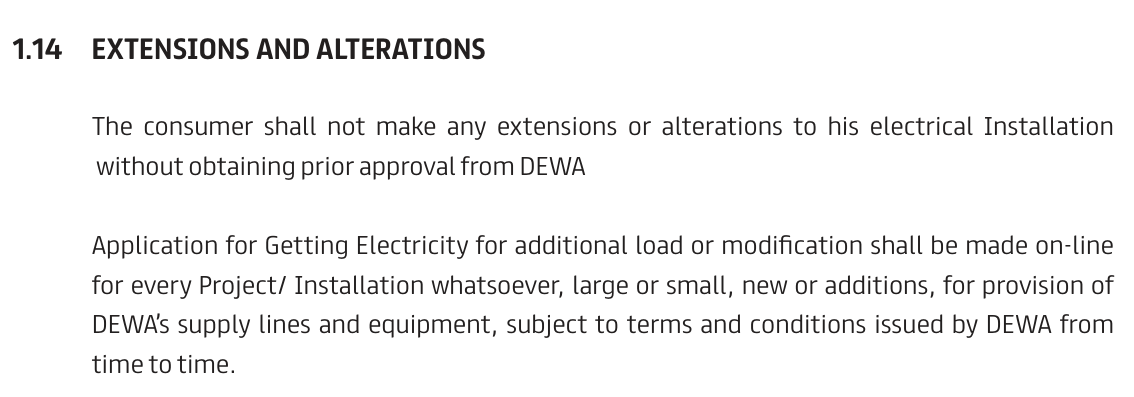
- No extension or alteration may be made without prior DEWA approval, and an application for additional load or modification is made online for every project, large or small (clause 1.14).
- Electrical design and installation work in Dubai is done by DEWA-enrolled firms, which protects the owner.
Why a villa's electrical installation needs care after handover
At handover the installation has been inspected and tested, and DEWA has released the supply (see our guide to the DEWA electricity connection for an annex). After that it lives in Dubai conditions: the 2017 Regulations list a maximum outdoor shade temperature of 48 °C and relative humidity of up to 100 % among the site conditions (PDF p. 9) and note that sand storms also prevail. Clause 1.13 names "external influences" among the factors that decide how often an installation is inspected. Over the years loads are added and boards are opened for small jobs, and a periodic check catches those changes while they are still small.
A sensible split of roles: the owner arranges the work, a DEWA-enrolled consultant or contractor carries out inspection, testing and any change, and DEWA reviews and approves what the Regulations require.
What DEWA says about maintenance, periodic inspection and testing
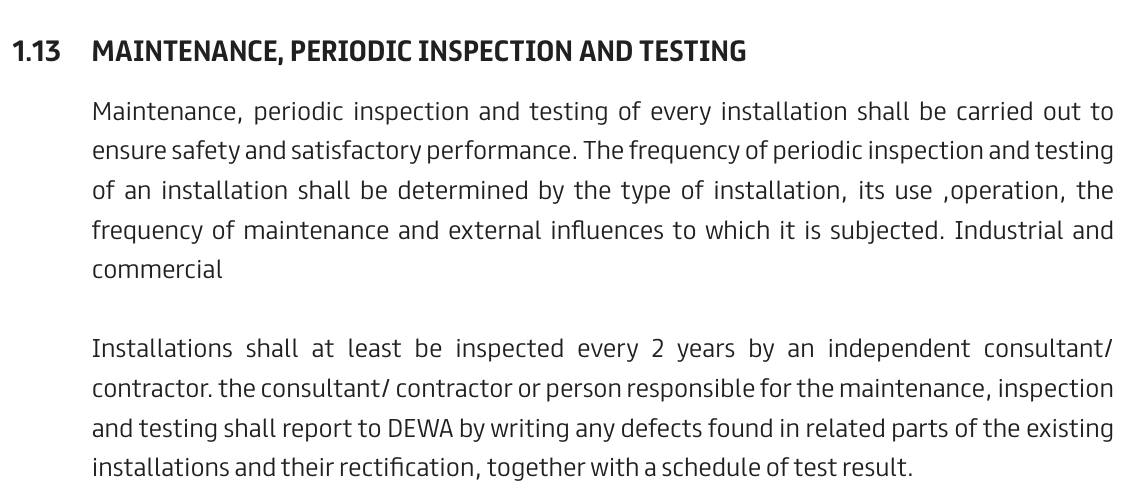
The wording is in clause 1.13 of the DEWA Regulations for Electrical Installations, 2017 Edition (PDF p. 15, printed page 13). In short:
- Maintenance, periodic inspection and testing of every installation shall be carried out to ensure safety and satisfactory performance.
- The frequency is determined by the type of installation, its use, operation, the frequency of maintenance and the external influences it is subjected to.
- Industrial and commercial installations shall be inspected at least every 2 years by an independent consultant or contractor.
- The consultant, contractor or person responsible for the maintenance, inspection and testing reports to DEWA in writing any defects found in related parts of the existing installation and their rectification, with a schedule of test results.
What the clause does not say about villas
The 2-year minimum is written for industrial and commercial installations. For a private villa the clause gives the factors that decide the frequency but no number, so we do not state an interval. Your enrolled consultant or contractor can advise how often to inspect your installation in the light of its use, loads, maintenance and exposure.
How the 2017 Regulations and the Dubai Building Code share the work
DEWA's circular DP-VP-CS-GEN-0008-2022 of 17 January 2022 explains the split. The clauses of the 2017 Regulations that apply to electrical design are incorporated in the Dubai Building Code issued by Dubai Municipality, mostly under Part G and Part K, and compliance with the Code is mandatory and verified when drawings are submitted for DEWA design approval for all projects in Dubai. For safety, the 2017 Regulations still include the applicable clauses on the operation, periodic inspection and maintenance of electrical installations, and DEWA says this guidance will be issued separately for easy reference.
So when this guide cites the 2017 Regulations for design values, the Dubai Building Code is the current design reference and your engineer confirms the value in force. For operation, inspection and maintenance, the clauses are still in the 2017 Regulations. We did not find the separate guidance among the DEWA documents we reviewed, so check DEWA's circulars page for anything newer. For the Code itself, see our Dubai Building Code guide.
What a periodic electrical inspection of a villa looks at
Clause 1.13 lists examples of items an electrical installation status report can refer to, "as applicable to the respective type of premises" (PDF pp. 16 to 20). It starts with a visual inspection of the external condition of all equipment that is not concealed, and further detailed inspection, including partial dismantling where needed, is agreed with DEWA. In plain terms, the main groups are:
| Area | Examples DEWA lists |
|---|---|
| Intake | Main or service cable, main earthing arrangements, metering cabling and equipment. |
| Earthing and bonding | The earth electrode arrangement, sizes and connections of earthing and bonding conductors, accessibility, and earthing and bonding labels. |
| Distribution boards | Working space, fixing, insulation and enclosures, main switch operation, manual operation of circuit-breakers and RCDs, the RCD test button, labels and schedules. |
| Circuits | Identification of conductors, cable support, tight connections, signs of thermal or mechanical damage, protective conductors, and a suitable cable type where exposed to direct sunlight. |
| Isolation and switching | Isolators that can be secured OFF and are clearly identified; emergency switching where it applies. |
| Equipment | Permanently connected equipment and recessed luminaires, with no signs of overheating to the surroundings or to conductors and terminations. |
Clause 1.12 (PDF p. 15) adds that the inspection and testing certificate completed at connection records results such as insulation resistance, continuity and earth electrode resistance tests, in the format of Appendix 3. We suggest keeping a copy as the baseline for later results.
Earth electrode, ECC and RCD checks
Earth electrode and ECC
Clause 5.2.7 (PDF p. 51) says the consumer's earth electrode resistance and the continuity of the earth continuity conductors (ECCs) shall be periodically checked and maintained to ensure consumer safety. Clause 5.2.5 prints a main earth electrode resistance not exceeding 1 ohm for each incoming DEWA supply or MDB, and clause 5.2.6 not more than 0.5 ohm from any point of an ECC to the main earth electrode; as design clauses now sit in the Dubai Building Code, your engineer confirms the values applied today. Clause 5.3.7 (PDF p. 52) says ECCs are labelled at their termination points with circuit numbers.
RCD and earth leakage protection
Clause 5.4.3 (PDF p. 53) says the operation of ELCBs and RCCBs and of earth leakage detection is periodically checked and tested. DEWA's inspection list also asks for confirmation that the RCD's integral test button makes it trip, and for the RCD quarterly test notice at or near the origin. The name indicates a quarterly test; the clauses we reviewed do not reproduce the notice's wording, so follow the notice on your own board.
Air-conditioning UV relays
Clause 1.10 (PDF p. 11) requires an under-voltage (UV) relay with an auto-reset timer for air-conditioning equipment, and clause 8.2.5 (PDF p. 67) says UV relays and their controls shall be checked and maintained regularly.
Labels and schedules at the distribution board
In our view, labels let a second person work on a board safely. DEWA's lists in clauses 1.12 and 1.13 (PDF pp. 12 to 13 and 16 to 17) include the items below, "where required", so your engineer confirms which ones apply to your installation.
| Label or document | Where DEWA says it belongs |
|---|---|
| RCD quarterly test notice | At or near the origin of the installation. |
| Diagrams, charts or schedules | At or near each distribution board. |
| Mixed cable colour warning notice | At or near the appropriate board, where required (non-standard, mixed cable colours). |
| Alternative supply warning notice | At the origin, at the meter position if remote from it, at the board where an alternative or additional source is connected, and at all points of isolation of all sources of supply (clause 1.12). |
| Next inspection recommendation label | Listed among the labels to be present; the lists we reviewed give no location. |
| Earthing and bonding labels | At all appropriate locations. |
| ECC circuit numbers | At the ECC termination points (clause 5.3.7). |
One difference between the lists: clause 1.12 (before connection) says the RCD quarterly test notice goes at or near the origin, while the periodic list in clause 1.13 says at or near the equipment, where required.
Before you alter or extend the villa installation
Clause 1.14 (PDF p. 20) is short and clear: the consumer shall not make any extensions or alterations to the electrical installation without prior approval from DEWA, and an application for additional load or modification is made online for every project or installation, large or small, new or additions. Clause 1.7 (PDF p. 10) adds that before any electrical installation, large or small, new or additional, begins, its technical details are submitted to DEWA for review and prior approval.
The clause gives no examples, so ask your enrolled engineer whether a particular job counts. Common candidates are new air-conditioning, a kitchen or workshop, a new room or annex, rooftop solar or an EV charger. For the application itself, see our guides on increasing the electrical load, connecting an annex and Shams Dubai rooftop solar.
Two practical points from DEWA's pages: changing the meter location after execution and supply release is not recommended and may revise the invoice, so settle it early; and moving a meter, substation or cable is a separate Electricity Network Modification service for enrolled contractors and consultants, with a free application and an estimate in 10 working days; the modification itself is chargeable where applicable.
Why DEWA-enrolled consultants and contractors protect the owner
Clause 1.4 (PDF p. 9) requires all consultants and electrical contractors to enrol with DEWA to undertake electrical design or installation works in any project or premises in Dubai. Clause 1.5 adds that each electrical contractor keeps the required minimum number of electrical engineers and technicians who know DEWA's Regulations and who supervise and test the entire electrical works before the supply is connected. On DEWA's connection page, only enrolled consultants and contractors can submit the application, so an owner cannot apply directly. Two older circulars addressed to enrolled firms, still listed on DEWA's circulars page with no note that they were replaced, point the same way:
- Circular SMCS/1289/2007 (10 December 2007) notes that some individuals had undertaken drawings, submissions and inspections as freelancers and says only enrolled electrical contractors and consultants shall carry out electrical works, using their own staff, in all projects.
- Circular HCS/160/2003 (23 February 2003) says installation works are carried out under the supervision of qualified electrical engineers, and only an engineer or technical staff at supervisor level or above attends inspections with DEWA; they show identification if asked.
Choosing an enrolled firm is the straightforward way to work within these rules. Before signing, ask for its DEWA enrolment, the name of the supervising engineer and the test results in writing. Our 12-point contractor checklist covers the contract side.
Protecting DEWA cables and meters on your plot during works
DEWA's Contractors and Consultants Guide on Law No. (6) of 2015 for the protection of the General Network of Electricity and Water in Dubai (February 2016, PDF pp. 13 to 17) gives a short list to respect.
- No one may work in a way that impacts DEWA's network without a prior permit from DEWA (PDF p. 14).
- Prohibited acts include damaging, cutting or exposing electricity cables, transferring power cables without DEWA's prior approval, storing materials or waste near electricity services, and building temporary chambers, foundations or obstructions near electricity lines (PDF p. 13).
- The permitted person provides cable detectors on site, does not start until DEWA's specified trial holes are made, advises DEWA of the schedule 48 hours before starting, and stops and notifies DEWA immediately if the work damages the network (PDF p. 16).
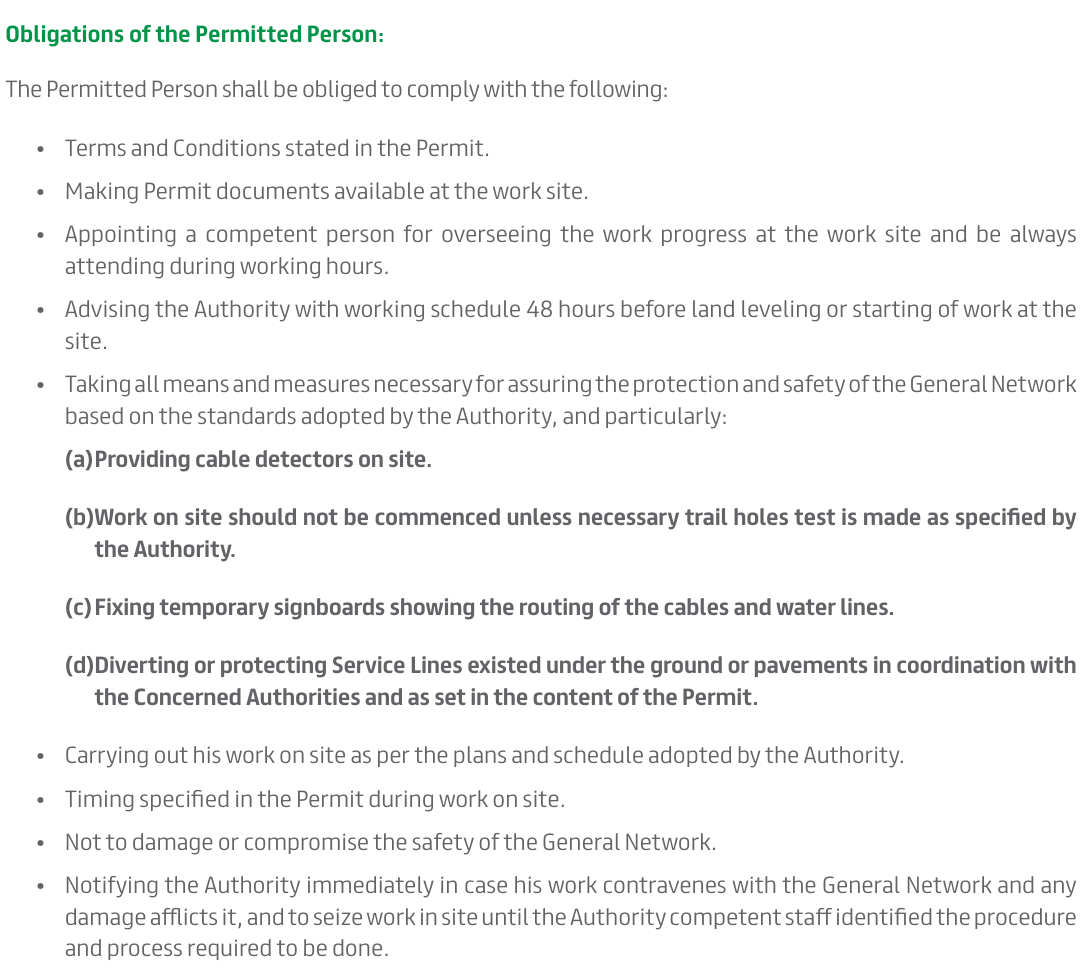
These obligations are addressed to the permitted person, usually your contractor. You help by showing where the DEWA cables and meter cabinet are on your plot and agreeing any new trench route in advance. For power on site, read our guide to temporary construction power.
A yearly owner routine and a records folder
This is our suggestion, not a DEWA requirement. It keeps you informed without touching live equipment.
- Look at the board, do not open it. Check the schedule, the RCD notice and any next-inspection label are present and legible. Covers are for the enrolled firm.
- Test the RCD as the notice says. The test button should make it trip; if not, call your enrolled contractor.
- List changes. Any new load, circuit, room or appliance goes on a list for the engineer, who will say whether it needs DEWA approval.
- Act on warning signs. Warm or discoloured fittings, frequent tripping or a burning smell are reasons to call your contractor promptly.
- Book the periodic check. Ask for an inspection and a written report with test results, and agree the next date.
In the records folder keep: the approved drawings and DEWA approvals; the inspection and testing certificate from connection; current board schedules and the single line diagram; periodic inspection reports and rectification notes; and the details of the enrolled firm and supervising engineer, with the dates of any alterations. With that folder an engineer can inspect, alter or extend the installation without guessing what is behind the walls.
How Al Mustafa Contracting helps owners after handover
We plan the electrical scope with the owner and the engineering office so drawings, labels and records are ready at handover. Our guide to inspections and the completion certificate shows where the electrical inspection sits in a project, and for a new home see our villa construction in Dubai page.
Frequently asked questions
How often should a villa's electrical installation be inspected in Dubai?
DEWA's clause 1.13 says the frequency depends on the type of installation, its use, operation, maintenance and external influences. It sets a 2-year minimum only for industrial and commercial installations and gives no interval for villas, so we do not state one. Ask your enrolled consultant or contractor.
Do I need DEWA approval to add a circuit or air-conditioning unit?
Clause 1.14 requires prior DEWA approval for extensions and alterations and an online application for additional load or modification, large or small. Ask your enrolled engineer whether your specific change counts.
Can an independent technician inspect or alter my installation?
Circular SMCS/1289/2007 says only enrolled electrical contractors and consultants shall carry out electrical works, using their own staff, including drawings, submissions and inspections. Ask the firm for proof of its DEWA enrolment before you sign.
Has DEWA published separate guidance on periodic inspection?
The January 2022 circular says it will be issued separately. We did not find it among the documents we reviewed, so check DEWA's circulars page for the latest.
Need help with the electrical side of your villa or annex?
We are happy to look at your plans and explain how these steps fit your project. Message us on WhatsApp, use the contact page, try the free cost calculator or browse our projects.
This article summarises official DEWA documents for owners and is not legal or engineering advice. The official DEWA documents and their current versions prevail.
Official sources
- DEWA: Regulations for Electrical Installations, 2017 Edition (clauses 1.4, 1.5, 1.7, 1.10, 1.12, 1.13, 1.14; clauses 5.2.5 to 5.2.7, 5.3.7, 5.4.3 and 8.2.5)
- DEWA: circular DP-VP-CS-GEN-0008-2022, Dubai Building Code incorporating DEWA Regulations for Electrical Installations (17 January 2022)
- DEWA: circular SMCS/1289/2007, Authorized Engineers of Electrical Contractors and Consultants
- DEWA: circular HCS/160/2003, Enforcement of DEWA's Regulations for Electrical Installations at Consumer premises
- DEWA: Contractors and Consultants Guide, Aspects of Law No. (6) of 2015 (February 2016)
- DEWA: Electricity Network Modification
Planning your next project?
Talk to the Al Mustafa team for advice and a quotation for your project in the UAE.