

14 min read
In this article
- DEWA LV inspection checklist in short
- Where the DEWA LV inspection sits in the connection steps
- The contractor tests first: the Inspection and Testing Certificate
- Earthing the DEWA inspector checks: electrode, pit and resistance
- Earth continuity conductors and bonding
- Earth leakage protection: the RCD test button and the quarterly notice
- The distribution board: main switch, schedules, labels and notices
- Cables and circuits: identification, support and protection
- Where 30 mA protection is expected
- Air-conditioning on the annex: under voltage (UV) relays are verified at inspection
- Padlockable breaker before the meter and metering cabinet readiness
- Pre-inspection checklist for the owner and the enrolled contractor
- How Al Mustafa Contracting prepares for the DEWA inspection
- Frequently asked questions
- Who requests the DEWA LV inspection?
- How long does the DEWA LV inspection take?
- What does the DEWA inspector check on an RCD?
- What earth electrode resistance does DEWA state?
- Do I need two earth pits?
- Need help preparing the electrical side of your annex?
- Official sources
A DEWA LV inspection for a villa or its service block (annex) is the last gate before the meter is installed and the supply is released: the contractor tests the installation first, then DEWA inspects it. It goes smoothly when the enrolled contractor arrives with the earthing, the earth leakage protection, the distribution board labels and the test results already in order. This guide turns DEWA's Regulations for Electrical Installations (2017 Edition) into a plain checklist for Dubai villa owners building an annex, majlis, service block or small G+ building, so you know what should be ready before the inspector arrives.
DEWA LV inspection checklist in short
- DEWA's Regulations say that all electrical installations and the equipment in them are subject to DEWA's inspection, testing and final approval before the electric supply is connected (cl. 1.12, PDF p. 12).
- The contractor inspects and tests the whole installation first, then requests the DEWA inspection (cl. 1.12). DEWA's Regulations say that DEWA-enrolled consultants and contractors submit the Getting Electricity application on the One Window System (cl. 1.8, PDF p. 10), so your enrolled contractor handles the request for you.
- The contractor's test results are submitted on DEWA's Inspection and Testing Certificate (Appendix 3, PDF pp. 96-97), and DEWA verifies the submitted results during its inspection (cl. 1.12, PDF p. 15).
- DEWA's own page states 1 working day for the LV inspection and says the result is given on the spot: approved, or a snag list.
- The things that most often decide the visit are physical and visible: the earth electrode and its pit, a working RCD test button, labelled boards and circuits, the notices and schedules at the board, and a padlockable breaker before the meter.
A note on the sources. The 2017 Regulations are the document quoted throughout. DEWA's circular DP-VP-CS-GEN-0008-2022 (17 January 2022) says the clauses for electrical design are now incorporated in the Dubai Building Code, mostly under Parts G and K, and that the 2017 Regulations still carry the clauses on operation, periodic inspection and maintenance. So the Section 5 clauses on earthing and earth leakage that this guide cites may be among those now incorporated in the Code. The circular does not list the clauses, so the enrolled engineer confirms which document governs these values on your project. Our Dubai Building Code guide explains that code for villa owners.
Where the DEWA LV inspection sits in the connection steps
The inspection is step four of the general connection path described in our guide to the DEWA connection steps. Before it, the Building NOC and the building permit from the authority where the plot is located are the prerequisites for applying for the connection (cl. 1.8, PDF p. 10), and the proposed technical details are submitted to DEWA for review and prior approval before any installation starts (cl. 1.7, PDF p. 10). DEWA's page states that the LV inspection is requested after site readiness and after the connection invoice is paid, that it takes 1 working day from submission, and that the result is given on the spot. If the result is approved, DEWA then confirms the date for meter installation and supply release.
DEWA's Regulations ask the contractor to confirm in the certificate that the work is in accordance with the DEWA approved documents and regulations (Appendix 3, PDF p. 96). If the drawings changed during construction, tell your engineer early; for a load increase see our guide on increasing the electrical load.
The contractor tests first: the Inspection and Testing Certificate
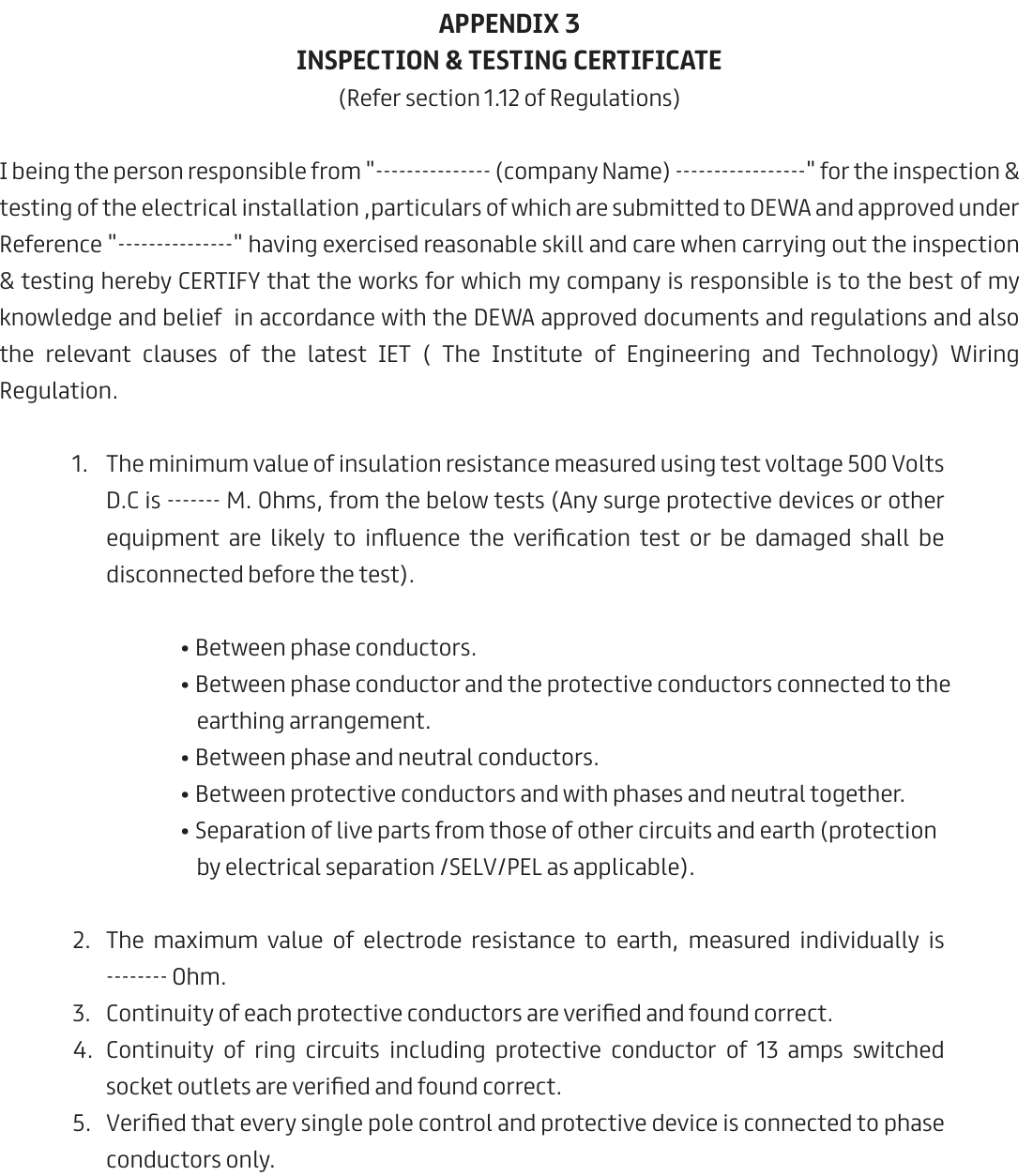
Clause 1.12 states that contractors shall carry out inspection and testing of the entire electrical installation before requesting the DEWA inspection, and that the certificate is completed through DEWA's Getting Electricity online One Window System. The results include insulation resistance tests, continuity tests and earth electrode resistance tests (cl. 1.12, PDF p. 15). The certificate in Appendix 3 lists what the responsible person certifies:
| Appendix 3 item | What the contractor certifies |
|---|---|
| 1 | Minimum insulation resistance at 500 V DC between phase conductors, phase and protective conductors, phase and neutral, and protective conductors with phases and neutral together; surge protective devices are disconnected before the test. |
| 2 to 4 | Maximum earth electrode resistance, measured individually; continuity of each protective conductor and of ring circuits. |
| 5 to 8 | Single-pole devices on phase conductors only; socket outlet and lamp holder wiring; barriers and IP ratings. |
| 9 to 11 | Tests on all the ELCBs; UV relays with their contactors or motorised breakers; power factor correction equipment. |
| 12 and 13 | Terminations, colour and circuit identification, caution labels and notices verified; equipment checked against the approved drawings (PDF p. 97). |
The practical point for the owner: ask your enrolled contractor for the completed certificate values before the inspection is requested, and keep a copy in the project file.
Earthing the DEWA inspector checks: electrode, pit and resistance
The Regulations require every consumer installation to have a separate earthing system within the consumer's plot limits, installed and maintained by the consumer (cl. 5.1.1, PDF p. 49). The clauses below sit in Section 5; as noted above, DEWA says the electrical design clauses are now incorporated in the Dubai Building Code but does not list them, so your engineer confirms which document governs these values against the approved drawings.
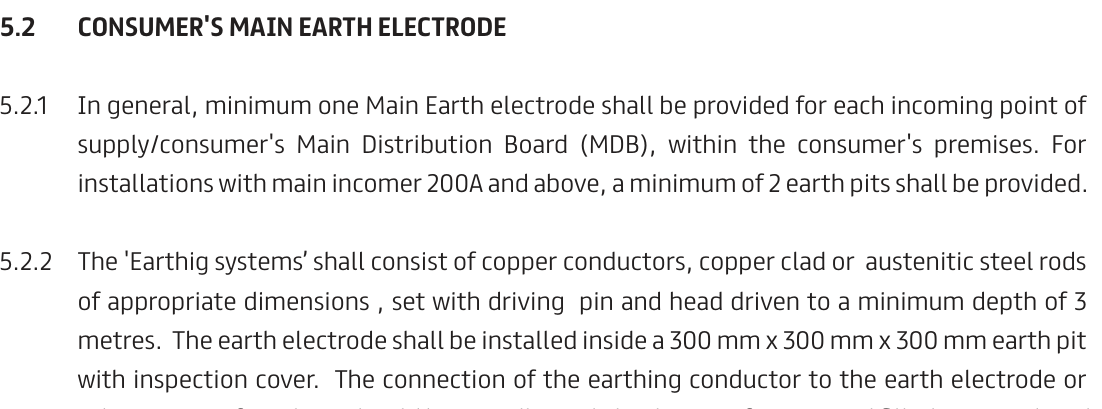
- Earth electrode: at least one main earth electrode for each incoming point of supply or main distribution board, and at least 2 earth pits where the main incomer is 200 A and above (cl. 5.2.1).
- Pit and depth: copper conductors, copper-clad or austenitic steel rods driven to a minimum depth of 3 metres, installed inside a 300 mm x 300 mm x 300 mm earth pit with an inspection cover (cl. 5.2.2).
- Resistance: the main earth electrode resistance shall not exceed 1 ohm for each incoming DEWA supply or MDB (cl. 5.2.5), and the resistance from any point of the earth continuity conductor to the main electrode shall not exceed 0.5 ohm (cl. 5.2.6, PDF p. 51).
- TN-S, neutral and earth separate: the main earthing connection is a TN-S system, and the neutral and earth conductors are kept separate and not connected together at the main earth terminal or at any other point in the installation (cl. 5.1.9 and 5.1.10, PDF p. 49).
DEWA's 2001 circular HCS/1223/2001 adds a reminder for consultants and electrical contractors: only good quality earth electrodes are to be installed, and the electrode resistance, size and ECC continuity at all connections are checked and tested in line with the Regulations. It is a 2001 circular that DEWA's circulars page still lists.
Earth continuity conductors and bonding
Every circuit in the main, sub-main and final distribution boards has its own green and yellow PVC-insulated copper earth continuity conductor (ECC), sized from Appendix 9 (cl. 5.3.1, PDF p. 51 and Appendix 9, PDF p. 119). ECCs are labelled at their termination points with circuit identification numbers (cl. 5.3.7, PDF p. 52), and gas pipes, metallic conduit and similar parts are not used as an ECC (cl. 5.3.9). The metal work of the installation, including metal water pipes, cable armour and metal containment, is connected with equipotential bonding conductors to the main earthing terminal, and the continuity is tested (cl. 5.5.1 to 5.5.4, PDF p. 53). A photo of the open earth pit and the labelled ECCs inside the board is a good record to keep.
Earth leakage protection: the RCD test button and the quarterly notice
The Regulations require earth leakage protection to be suitably designed and incorporated in each and every consumer installation (cl. 5.4.1, PDF p. 52). The ELCBs or RCCBs generally comply with BS EN 61008 and BS EN 61009, and Appendix 10 gives recommended operating currents by circuit type (cl. 5.4.2, PDF p. 53 and Appendix 10, PDF p. 120). For example, the table lists 30 mA for 13 A switched socket outlets, water heaters, refrigerators and washing machines and domestic water pumps, and 100 mA for window or split-type air conditioners. Your engineer selects the values on the approved design; the inspector's list covers whether the devices work.
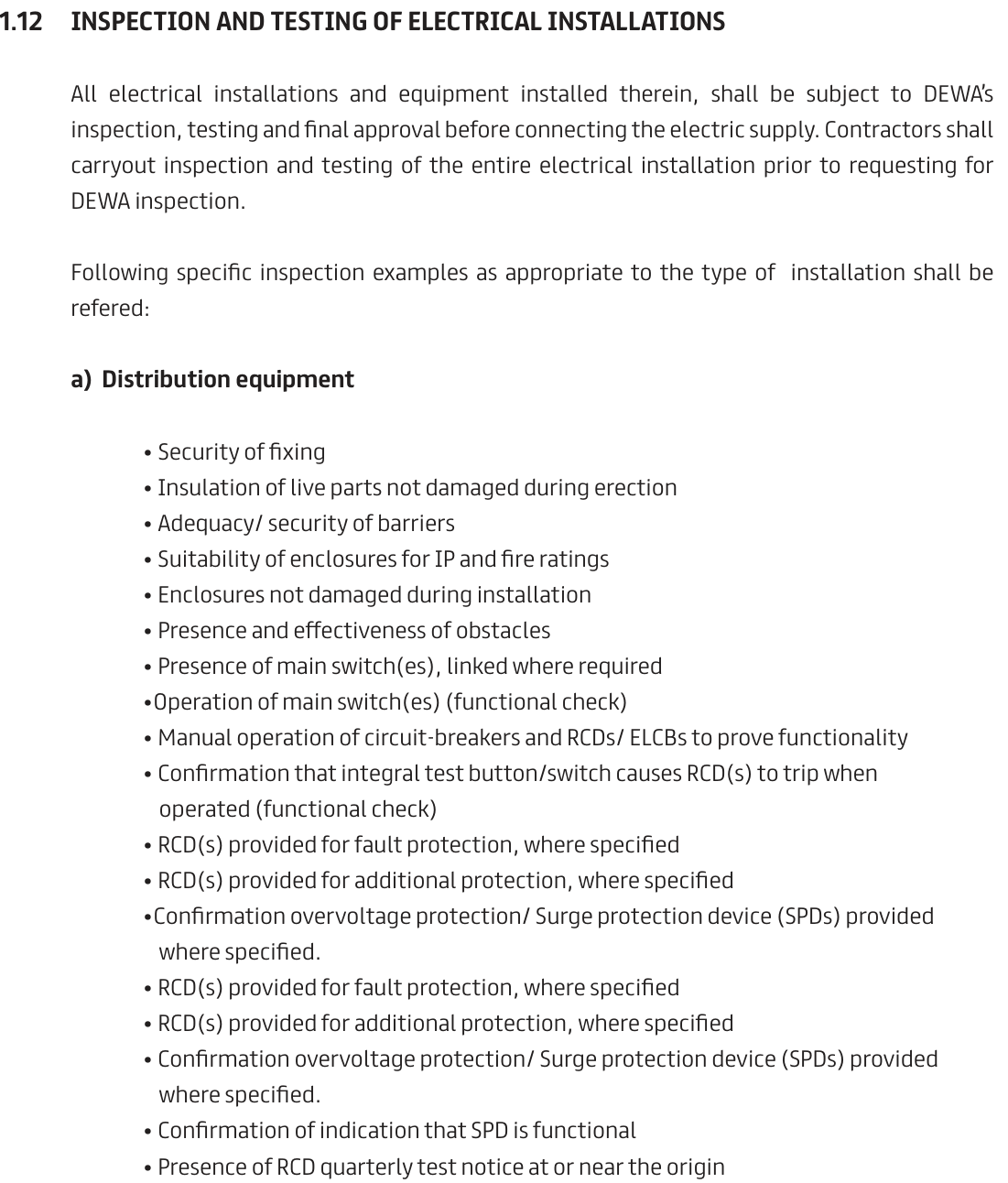
That list, in clause 1.12, includes manual operation of the circuit breakers and RCDs or ELCBs to prove functionality, and confirmation that the integral test button causes the RCD to trip when operated (a functional check). It also includes the presence of an RCD quarterly test notice at or near the origin. The practical tip is simple: before the visit, have the contractor press the test button on every RCD and ELCB, confirm each trips, and fit the quarterly test notice at the main board.
The distribution board: main switch, schedules, labels and notices
The distribution equipment list in clause 1.12 (PDF pp. 12-13) reads like a walk-around of the board. DEWA lists these as examples, as appropriate to the type of installation:
- presence and operation of the main switch or switches, linked where required;
- presence of diagrams, charts or schedules at or near each distribution board, where required;
- a warning notice for non-standard (mixed) cable colours at or near the board, where required;
- an alternative supply warning notice where there is an alternative or additional source, for example at the origin and at the meter position if it is remote;
- presence of the next inspection recommendation label, and of other required labelling;
- correct type and rating of protective devices, and tight, secure connections in the terminals.
Make sure the circuit names on the schedule match the labels on the breakers and on the ECCs. A printed label sheet from any source is only a convenience; the rule comes from clauses 1.12 and 5.3.7, and your engineer decides the wording.
Cables and circuits: identification, support and protection
The circuits list in clause 1.12 (PDF pp. 13-14) covers identification of conductors, cables correctly supported throughout, no signs of mechanical damage, non-sheathed cables enclosed in conduit, ducting or trunking, adequate current carrying capacity, presence of circuit protective conductors, and cables concealed in walls, floors or ceilings protected against damage. Terminations are checked too, and so are isolators: they should be capable of being secured in the OFF position and clearly identified by location or durable marking.
Where 30 mA protection is expected
Clause 1.12 lists the cases where additional protection by RCDs or ELCBs with a rated residual operating current not exceeding 30 mA is checked (PDF p. 13):
- circuits supplying mobile equipment not exceeding 32 A rating for use outdoors;
- all socket outlets of 20 A rating or less, unless exempt;
- cables concealed in walls at a depth of less than 50 mm;
- cables concealed in walls or partitions containing metal parts, regardless of depth.
Outdoor mobile-equipment circuits, sockets of 20 A or less and shallow concealed cables are the cases the clause names. Whether a given socket is exempt is for the design; we do not state it here.
Air-conditioning on the annex: under voltage (UV) relays are verified at inspection
If the annex has air conditioning, note that clause 1.10 (PDF p. 11) requires all air-conditioners and air-conditioning units, plants or equipment within the consumer installation to have an under voltage (UV) relay with an auto-reset timer, and item 10 of the Appendix 3 certificate has the contractor certify that the UV relays with their contactors or motorised breakers are verified and correct (PDF p. 96). Our separate guide on DEWA under voltage relays for air conditioners covers the detail.
Padlockable breaker before the meter and metering cabinet readiness
DEWA circular HCS/1076/2002 (19 October 2002) states that in all new projects the circuit breakers or MCCBs installed before tariff metering shall have provision for padlocking in the OFF position, and that consultants, contractors and distribution board suppliers incorporate this in drawing submissions and installations. It is an older circular that DEWA's circulars page still lists, so confirm the current practice with your engineer.
For the meter cabinet and room, DEWA's connection page lists the documents your engineer submitted: the layout showing the LV room, kWh meter and main distribution board, and the dimensions of the electrical room or cupboard. DEWA's builder FAQ adds that changing the meter location after execution and supply release is not recommended and may revise the invoice. DEWA's page also says a site photo is submitted with the LV inspection request. Where the cabinet goes in the compound wall and how far it sits from the water meter is covered in our guide to DEWA meter location for a villa.
Pre-inspection checklist for the owner and the enrolled contractor
| Item | Who | Source |
|---|---|---|
| Site ready, installation and wiring complete, connection invoice paid | Owner and contractor | DEWA connection page |
| Whole installation tested; Appendix 3 values ready | Contractor | Cl. 1.12; Appendix 3 |
| Earth electrode driven at least 3 m, pit 300 mm with cover, two pits if the incomer is 200 A or more | Contractor | Cl. 5.2.1, 5.2.2 |
| Electrode resistance within 1 ohm, ECC continuity within 0.5 ohm; recorded values | Contractor | Cl. 5.2.5, 5.2.6 |
| Green and yellow ECC on every circuit, labelled at terminations; bonding connected | Contractor | Cl. 5.3.1, 5.3.7, 5.5 |
| Every RCD and ELCB tripped with its test button; quarterly test notice fitted | Contractor | Cl. 1.12 |
| Main switch operates; schedules, mixed-colour and alternative-supply notices fitted where required; next inspection label present | Contractor | Cl. 1.12 |
| UV relay on each air conditioner verified | Contractor | Cl. 1.10; Appendix 3 item 10 |
| Padlock provision on the breaker before the meter; meter cabinet clear and as drawn | Contractor | Circular HCS/1076/2002; connection page |
A snag list is simply the list of items to fix before the next request. See also our guides to the Dubai Municipality inspections and completion certificate and the contractor checklist for where this step sits in the whole project. If you need power during construction, read temporary construction power.
How Al Mustafa Contracting prepares for the DEWA inspection
We plan the electrical scope together with the owner and the engineering office, so that the earthing, board labelling and test records are prepared as part of the build rather than at the end. In practice that means walking the board with a checklist like the one above before the inspection is requested, keeping photographs of the earth pit and the labelled terminals, and telling the owner in good time which signatures or payments DEWA needs. You can browse our projects or read about villa construction in Dubai.
Frequently asked questions
Who requests the DEWA LV inspection?
Your enrolled contractor handles it. DEWA's Regulations say the contractor tests the whole installation before requesting the DEWA inspection (cl. 1.12), and that DEWA-enrolled consultants and contractors submit the Getting Electricity application on the One Window System (cl. 1.8), where customers can follow the status.
How long does the DEWA LV inspection take?
DEWA's connection page states 1 working day from submission, with the result given on the spot, either approved or a snag list.
What does the DEWA inspector check on an RCD?
Among the examples in clause 1.12: manual operation to prove functionality, that the integral test button causes the RCD to trip, and the presence of the RCD quarterly test notice at or near the origin.
What earth electrode resistance does DEWA state?
The 2017 Regulations state that the main earth electrode resistance shall not exceed 1 ohm for each incoming DEWA supply or MDB, and 0.5 ohm from any point of the ECC to the main electrode (cl. 5.2.5 and 5.2.6). DEWA's circular of 17 January 2022 says the electrical design clauses are incorporated in the Dubai Building Code, while the 2017 Regulations still carry the operation, periodic inspection and maintenance clauses. The circular does not list the clauses, so your engineer confirms which document governs these values on your project.
Do I need two earth pits?
The Regulations require a minimum of 2 earth pits where the main incomer is 200 A and above (cl. 5.2.1); otherwise at least one main electrode per incoming supply. Your engineer confirms which applies.
Need help preparing the electrical side of your annex?
We are happy to look at your plans and explain how the inspection fits your project. Message us on WhatsApp, use the contact page or try the free cost calculator.
This article summarises official DEWA documents for owners and is not legal advice. The official DEWA website, its current Regulations and the Dubai Building Code prevail, and the inspection is carried out by DEWA and your enrolled engineer or contractor.
Official sources
- DEWA: Regulations for Electrical Installations, 2017 Edition (cl. 1.7, 1.8, 1.10, 1.12, Section 5, Appendices 3, 9 and 10)
- DEWA: Circular DP-VP-CS-GEN-0008-2022, Dubai Building Code incorporating DEWA Regulations for Electrical Installations (17 January 2022)
- DEWA: Circular HCS/1223/2001, consumer's earthing system (9 December 2001)
- DEWA: Circular HCS/1076/2002, padlocking arrangement for circuit breakers installed before tariff metering (19 October 2002)
- DEWA: Getting Electricity Permits and Connections (LV inspection steps and times)
- DEWA: Builder FAQ
Planning your next project?
Talk to the Al Mustafa team for advice and a quotation for your project in the UAE.
Related articles
 17 November 2026Periodic Inspection of a Villa Electrical Installation in Dubai: Alterations, Labels and Upkeep After HandoverRead article
 15 November 2026Building an Annex or Majlis with MBRHE Support: A Practical GuideRead article